Small Things Like These

Although the circular firing squads have already formed and are carrying out their appointed tasks, I, for one, feel it’s too early to get a firm grip on why Donald Trump was able to win not only the electoral college, with its historic roots sunk deep in the soil of slavery, but the popular vote as well. For those less inclined to wait, the culpable parties include Inflation, an economy measured by the cost of eggs rather than bridges built or the Dow Jones index, working class anger, racism, misogyny, the “deplorables,” the Gaza war, elitism, an electoral system marinating in cash – an estimated $16 billion was spent on the current presidential election alone, more than the GDP of 51 countries! – and the weak standing of a current president which was passed down to his successor, not to mention the Democratic Party or the Republican Party, take your pick.

As I always have an eye out for the education sector, one factor stood out for me, yet again. Exit polling by both CBS and NBC revealed that educational achievement remains the most likely predictor of voting preference, having surpassed income levels some cycles ago.
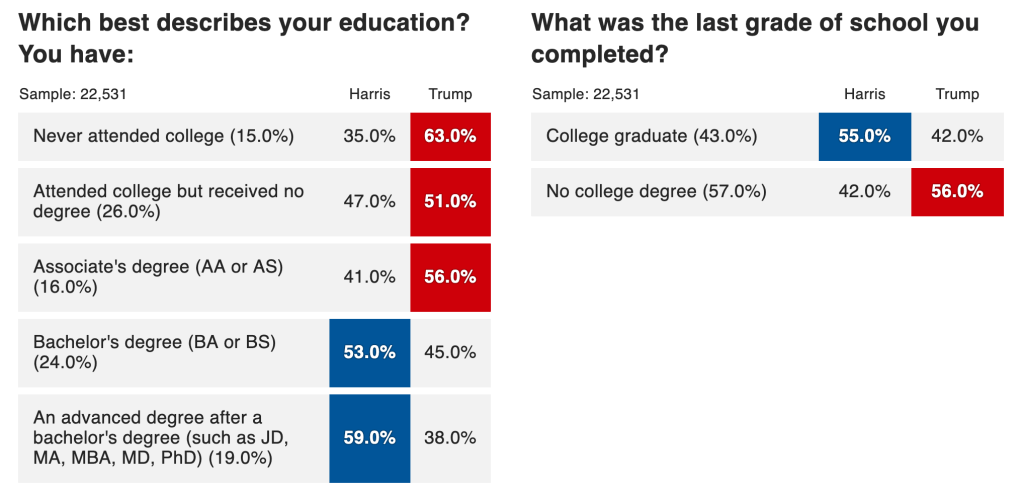

Those of us in higher education have a lot to think and talk about in the months and years ahead.

For the moment, though, something else is on my mind. My wife and I went to see “Small Things Like These” over the weekend at a nearby cinema. Based on the spare novel by Claire Keegan, the film is set in Ireland in the 1980s. “Small Things” follows Bill Furlong (played by a magnificent Cillian Murphy), a man of few words and troubled memories, who delivers coal to the inhabitants of his small Irish town. Surrounded by his wife and their five girls, Furlong doesn’t drink, cares for his family, and works diligently at his back-breaking, monotonous job, He gets by, if barely, and generally without complaint. Still, he often lies awake in the middle of the night, staring out to the street and wondering “what was it all for?”

Continue reading
Immigration and the 2024 Election: Misconceptions, Deceits, and Bald-faced Lies

What follows is an extended and revised version of two talks I gave recently in Oberlin. Feel free to use any part of this, or the whole thing, in your own presentations, classes, blogs, or door-knocking opportunities.


As I write this, the election is fast approaching and for candidate Trump, immigration has displaced the economy as the “No. 1” issue. “That beats out the economy. That beats it all out to me, it’s not even close,” he concluded in mid-October. And, while more voters rank the economy and the high cost of living as their most important issue, 82% of Trump supporters and a whopping 61% of all voters put immigration as the most important challenge facing the country.

This is odd, one could even say weird. Whatever you think about immigration, it is unlikely to directly impact most lives, certainly not to the extent that, say, health care or education does. And immigration hardly represents an existential threat to the nation’s future (unless, of course, you think that America’s future rests in its enduring whiteness). If we wanted to talk about existential threats, we would be talking about climate change.

But immigration has become a serious issue for our future – not because of who immigrants are or how many are here, but because of how we as a nation have responded to them. A recent poll found that more than 60% of Republicans and nearly one-third of all Americans agree with Trump’s denunciation that immigrants are “poisoning the blood” of the country. Let’s repeat that: 3 out of every 5 Republicans are in agreement with one of the central underpinnings of both Nazism and white supremacy: the ideology of blood purity. The conviction that our blood contains not just cells and plasma but race, nationality, and “purity,” is a fiction that led to the murder of millions of Jews in Europe and the perpetuation of slavery and Jim Crow in America. Trump has introduced this abomination into his campaign, and, it appears, a considerable segment of US voters is buying it.

Continue reading

How to be Jewish: On Being Schooled by the House Committee on Education

At a time in which we all seem to have followed Alice through the looking glass, some comments from the most recent hearing of the House Committee on Education and the Workplace might not rank very high on our list of puzzlements. Certainly not as high as, say, MAGA followers describing Hunter Biden’s conviction on two felony counts as further proof that the rigged Justice Department was actively engaged in covering up the “true crimes” of the “Biden Crime Family.” But the comments caught my attention, nonetheless.

The committee hearings were the fourth set convened in the wake of the brutal October 7 Hamas attack on Israel and the support which some student organizations at Harvard had shown for the assault. In its first two hearings, Republican committee members had succeeded in humiliating the leaders of Harvard, Penn, and MIT, and in providing the president of Columbia a stage on which she could humiliate herself. Claiming that university presidents had allowed antisemitism to thrive on their campuses, Republicans charged the campus leaders with everything from a failure to provide Jewish students with a safe environment to maintaining silence in the face of a call for Jewish genocide. (At a third hearing, the superintendents of three liberal-leaning school districts in New York City, Berkeley, and Montgomery County, Maryland, successfully avoided the traps that had ensnared their university colleagues and demonstrated a much clearer sense of how to uphold their educational mission while also supporting their staff and students.)

Continue reading

Evaluating Teaching: Can We Get Beyond the Banality of SETs?

When I first began teaching in a tenure track position, my colleagues advised me that I had joined a department with a deep bench of knockout lecturers. One, I was told, could breeze through a detailed 50-minute lecture without once glancing at his notes (which he conspicuously placed on the lectern at the start of each class so as not to unsettle the students). The A-team’s lecturing prowess was reflected in the outstanding teaching evaluations they received (and is still vividly recounted by their 60- and 70-year old former students who return to campus for alumni weekend). If I wanted to garner equally stellar evaluations, it was impressed on me, I would have to step up my lecture game.

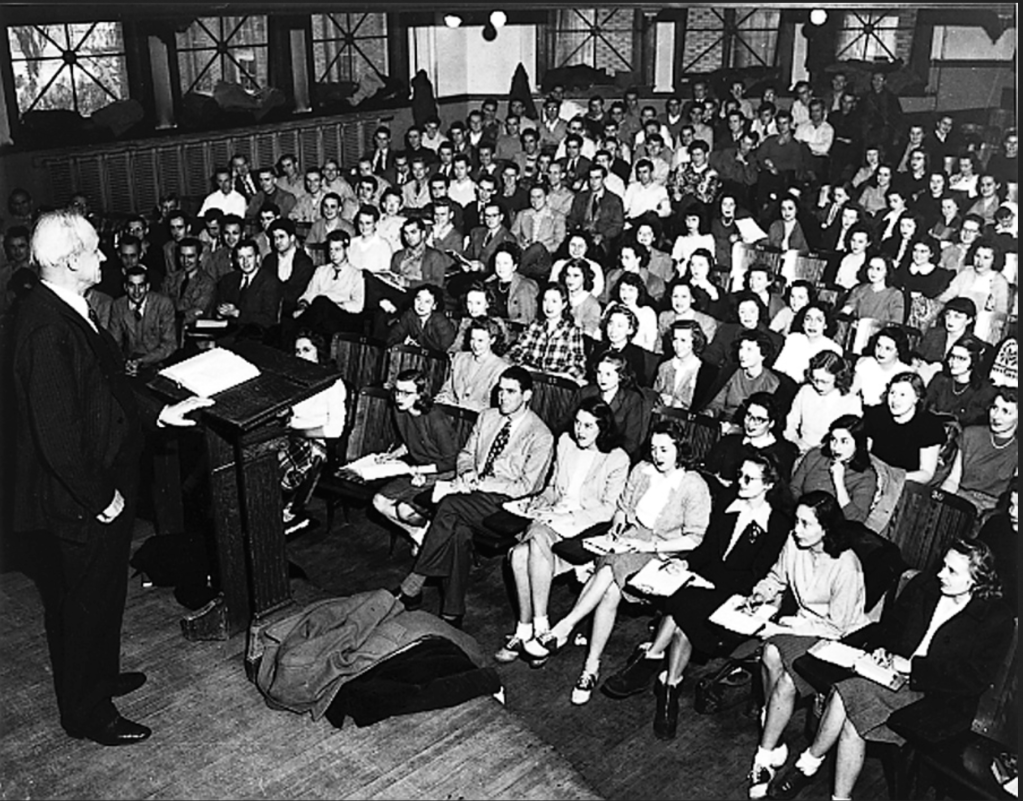
Economics Professor William H. Kiekhofer, lecturing in 1940 (Univ. of Wisconsin Archives).

I actually got pretty good at it – not to the level of memorization, but still good enough to boost my evaluations. All good, until it dawned on me that lectures could be inspirational, drawing students into the subject matter, but they weren’t the best way to promote student learning. And even the best lecture didn’t seem to capture the interest of those who purposefully occupied the back rows in my classes. My evaluations, while often good for my ego and, no doubt, helpful in my yearly evaluations, didn’t indicate whether any learning was taking place in class.

Encouraged by some reading in the scholarship of teaching and learning, greatly inspired by colleagues near and far, and (by then) protected by tenure, I moved away from lecturing in an effort to better address student learning. I had changed my classroom practice – but the evaluation process remained remarkably static, still using the same end-of-term questions to measure my effectiveness as a teacher.

Continue reading

Never Bring a Knife to a Gun Fight: Lessons from the December 5 Congressional Hearings

I have spent the better part of a month pondering what to make of the House Education and Workforce Committee’s December 5 public flogging of the presidents of Harvard, the University of Pennsylvania, and MIT. Much of the criticism heaped on the presidents’ heads after the hearings condemned them for being “evasive” when they should have been forceful, and for retreating into “context” and “lawyerly responses” when a “one-word answer” was in order. But, context actually matters – just ask Donald Trump’s lawyer, John Sauer, who couldn’t give a one-word answer when questioned by a federal appeals judge if a president would be immune from prosecution after ordering the assassination of a political rival. And context matters, as well, in terms of how we think about a reasoned response to the congressional thrashing to which the university leaders were subjected. Here, then, is a bit of my context.

I am Jewish. When Hamas attacked Israel on October 7, I did what many Jews did at that moment: feeling alone and vulnerable, I drew closer to my (literal and universal) Jewish family. Surprisingly, to me at least, I connected rapidly with the trauma that is a part of our history, the fear that is a part of our DNA, and a loneliness that I hadn’t thought about before. As the war expanded into Gaza, I also understood, as a Jew, our responsibility to never forget the humanity of all people, particularly given our own history of enslavement and oppression. This same ethical orientation has placed me on the political left where I have been for my entire adult life.

I am also an academic, not just in the professional sense of having spent most of my career teaching college students, but by observing, investigating, and critiquing higher ed during many of those years. In that examination, I have encountered much over the past few decades that has led me to worry that academia is losing its way. Beth Benedix, and I analyzed a number of the factors responsible for what we consider to be a crisis in liberal education in The Post Pandemic Liberal Arts College: A Manifesto for Reinvention.

Continue reading