What follows is an extended and revised version of two talks I gave recently in Oberlin. Feel free to use any part of this, or the whole thing, in your own presentations, classes, blogs, or door-knocking opportunities.
As I write this, the election is fast approaching and for candidate Trump, immigration has displaced the economy as the “No. 1” issue. “That beats out the economy. That beats it all out to me, it’s not even close,” he concluded in mid-October. And, while more voters rank the economy and the high cost of living as their most important issue, 82% of Trump supporters and a whopping 61% of all voters put immigration as the most important challenge facing the country.
This is odd, one could even say weird. Whatever you think about immigration, it is unlikely to directly impact most lives, certainly not to the extent that, say, health care or education does. And immigration hardly represents an existential threat to the nation’s future (unless, of course, you think that America’s future rests in its enduring whiteness). If we wanted to talk about existential threats, we would be talking about climate change.
But immigration has become a serious issue for our future – not because of who immigrants are or how many are here, but because of how we as a nation have responded to them. A recent poll found that more than 60% of Republicans and nearly one-third of all Americans agree with Trump’s denunciation that immigrants are “poisoning the blood” of the country. Let’s repeat that: 3 out of every 5 Republicans are in agreement with one of the central underpinnings of both Nazism and white supremacy: the ideology of blood purity. The conviction that our blood contains not just cells and plasma but race, nationality, and “purity,” is a fiction that led to the murder of millions of Jews in Europe and the perpetuation of slavery and Jim Crow in America. Trump has introduced this abomination into his campaign, and, it appears, a considerable segment of US voters is buying it.

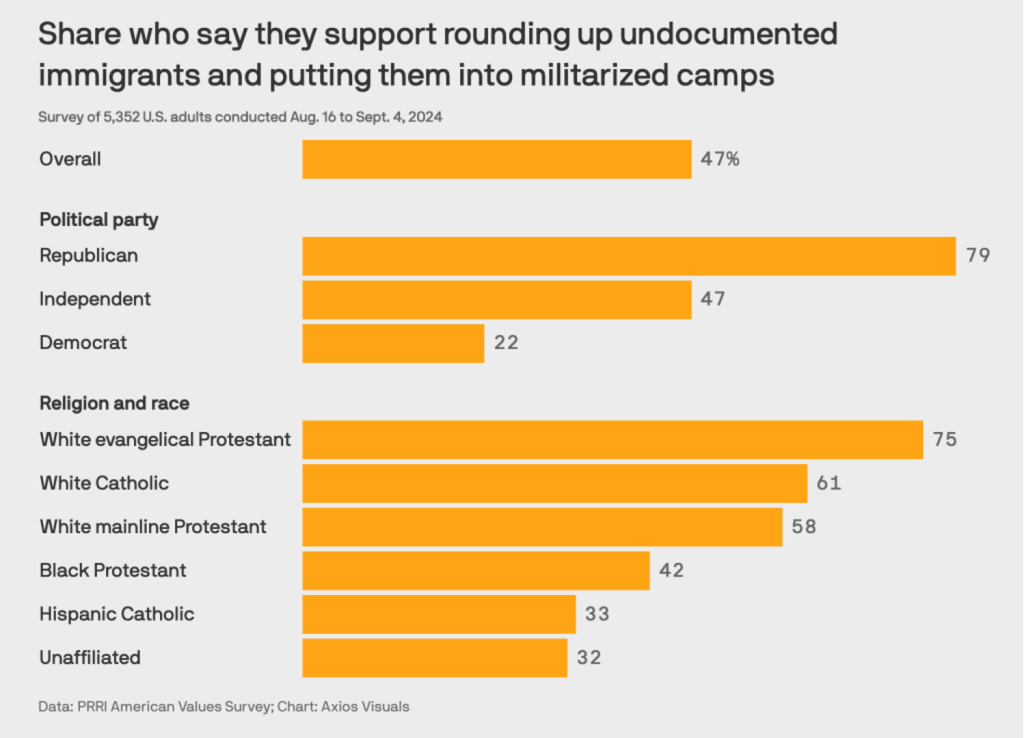
Equally troubling for the state of American democracy are the results of another recent poll indicating that nearly 80% of Republicans and half the US population supported the proposition that “undocumented immigrants should be rounded up and put into militarized camps.”
Since 2010, in this hemisphere alone, 25 million people have been displaced as a result of mounting instability, violence, and the devastating consequences of climate turmoil. (The global figure is around 120 million.) And yet in the face of this — more likely because of it, Americans have largely turned their back on migrants and attempted to outsource the crisis to other countries. Evidence of this? In 2020, 28 percent of those polled said that immigration to the US should decrease. This year, 55 percent agreed that immigration should decrease.
The constant negative messaging about immigration has raised its profile as political red-meat while opening immigrants to violence and increasing danger, as we have seen in cities like Springfield, Ohio and Aurora, Colorado. Because immigrant-bashing has proven so potent politically for Trump and the Republicans, many of the misconceptions and deceits about immigration have bled over and become bipartisan. That means that, regardless of who wins the 2024 election, those who support our immigrant communities and defend immigrant rights will have a lot of work to do.
Legal vs. Illegal
Let’s begin with one fallacy that is shared by both Kamala Harris and Trump, that the United States has been overrun, swamped, flooded — pick your own scare word — by “illegal” immigration. Trump refers to the increase of immigration as an “invasion.” Harris and Biden talk more of a “surge” that needs to be contained. Both imply that the vast majority of the immigrants who arrive on the border are “illegal,” and that immigrant numbers should be reduced.
This past June, the administration shut the border to asylum seekers after the seven-day average for “illegal” crossings hit 2,500 a day. The border would reopen to them only after the number of “illegal” encounters remained below a daily average of 1,500 for two weeks in a row. Then, in September, Biden expanded this threshold to 4-weeks in a row – a metric that hasn’t been reached to date and is unlikely ever to be achieved.

But some clarifications are required before we continue. An “Illegal” crossing, in the context of the Biden directives, applies to any migrant who shows up at a port-of-entry without an established appointment or who enters the country at some place other than a legal port-of-entry. Yet, under US and international law, most of these “Illegal” crossings are not actually illegal. Migrants who cross the border at any point and without authorization can present a credible fear case for asylum and be released into the US to await a court appearance. That is their right under law. But, for the most part, and with some exceptions including the 1,450 migrants a day who have been able to schedule an appointment with border agents by accessing a single app on their cell phones, and for minors who cross the border alone, the Biden order suspends longtime guarantees that give anyone who steps onto U.S. soil the right to petition for asylum.
[Breaking news: On October 23, the Ninth Circuit Court of Appeals largely affirmed a lower court decision that held unlawful the government’s systematic turnbacks – or “metering” – of people seeking asylum at ports of entry along the U.S.-Mexico border. This ruling, affirming that government has a legal duty to provide a fair and meaningful legal process to all people seeking safety at our border, and that Border agents cannot arbitrarily turn people back to Mexico, does not yet apply to the Biden Administration’s 2024 “metering” attempts. That is the subject of an additional lawsuit.]
The clear intent of Biden’s policy was to reduce the number of border “encounters” before the 2024 election, and it worked. The 250,000 “encounters” recorded in December 2023 were reduced to about 54,000 this past September.
There is a second aspect to Biden’s immigration policy likely to be carried on by Harris, that it important to understand. It’s not a stretch to argue that the administration’s harsh border policies were motivated by a hard-nosed realization that Biden (and then Harris) surely would lose the election without addressing the large numbers of migrants who were attempting to enter the US in 2022 and 2023 and whose arrival at the border was constantly, and graphically, a leading news item.

But, beyond the border, Biden has issued a number of measures to support immigrants already in the country. His most notable initiative was the attempt to provide a legal pathway to permanent resident status and citizenship for undocumented immigrants married to US citizens. (Like other pro-immigrant programs, this one has been challenged in federal court by 16 Republican-led states). Further, the bi-partisan border deal that didn’t get past the Republicans, while regressive for those seeking to enter, would have added more family and employment-based visas and ensured green-card eligibility for the children of immigrants who are in the country on certain guest labor programs. Harris has indicated that she supports DACA – the Obama-era program to protect young children brought by their parents to the country – and has urged Congress to pass legislation to permanently protect some 800,000 so-called Dreamers. (A Republican lawsuit against DACA is currently being decided in the Fifth Circuit, the nation’s most conservative, and is in grave danger of being overturned either there or when it reaches the Supreme Court.) Finally, under Biden, undocumented workers have had some protections from ICE raids, a constant threat during the Trump years.
To vote or not?
So, what is there to say to a voter who asks: “Why should I vote for Harris since she supports an awful border policy? Why shouldn’t I vote for a third-party candidate or just stay home?”
It’s a fair question for a voter for whom immigration is a critical issue. Harris, I would answer, has proposed immigration policies which have negative and positive aspects. Trump, on the other hand, has changed the focus of his 2020 “Build the Wall” campaign to a 2024 “Mass Deportation Now!” campaign that directly targets our immigrant brothers and sisters. Whether he actually carries it out (see below) or just uses it as a threat to hound immigrants further into the shadows, we cannot ignore the vast damage it will do.

As the editors of The Nation recently wrote, “Leftists contemplating voting for a third party in protest of Harris’s shortcomings…need to ask themselves why their particular cause, or their personal discomfort, is more important than making sure that Trump…[is] defeated decisively…” To paraphrase Angela Davis, elections are not popularity contests. You vote for the candidate you think will open the most space for organizing around positions that will advance social justice.
Mass Deportation Now!
In his often-cited commencement speech at Kenyon College some years back, David Foster Wallace related a story involving two young fish who meet an older fish swimming the other direction. “Morning, boys,” he greets them. “How’s the water?” The two young fish carry on for a bit, when one looks at the other and goes, “What the hell is water?”
Trump’s supporters are so used to splashing around in the bilge about immigrants that flows from his mouth that they no longer recognize it for the sewage it is. And, as I suggested above, it’s not just Trump’s supporters who share his delusions about immigration and immigrants. All of us are bathing in polluted waters.
Trump’s singular immigration “policy” is getting rid of immigrants, beginning with the deportation of all non-citizens without “green cards” (permanent immigrant status), and going on to remove those with Temporary Protected Status or other parole programs that allow hundreds of thousands of immigrants to live in the United States for short periods without a visa or green card. He has long opposed DACA, and promised to suspend guest workers visas for those who come from what he has termed “shithole” countries.
Should Trump carry out his deportation plans, an estimated 4.1 million mixed-status families could be separated. And who better to do this than Tom Homan, the official who oversaw Trump’s family separation policy during his administration. Trump has said he would welcome Homan into a new administration.
Trump has indicated that he would tap into two historical precedents to legitimize and operationalize his deportation desires, each of which has a dreadful history. One, tagged with the racist title of ‘Operation Wetback’, used military tactics to round up and remove about 1.3 million Mexican immigrants in the 1950s. Trump indicated he would deploy the National Guard this time around, using troops activated by sympathetic Republican governors. “The Alabama National Guard is going to arrest illegal aliens in Alabama and the Virginia National Guard in Virginia,” according to Stephen Miller, the person most likely to turn Trump’s anti-immigrant dreams into actual policy. “And if you’re going to go into an unfriendly state like Maryland, well, there would just be Virginia doing the arrest in Maryland, right, very close, very nearby.”

The second historical artifact, the Alien Enemies Act of 1798, was last used to detain and hold Japanese Americans in internment camps during World War II. (That Trump is incapable of irony and ignorant of history was again evident when, in defending the insurrectionists jailed for their actions on January 6, he argued that “Nobody’s ever been treated like this. Maybe the Japanese during the Second World War, frankly. They were held, too.”) Nevertheless, Trump warms up his rallies by promising that “getting [immigrants] out will be a bloody story.”
They moral costs of mass detentions and deportations are immense. But the economic expense is no less staggering, even if only talking about the actual costs of detention and deportation, and not the losses suffered because of their removal. CBS News recently estimated that apprehending and deporting just one million people could cost an estimated $20 billion. Do the math: for 11 million people, the costs would rise to $220 billion; for the 20-25 million individuals that Trump and Vance cite at their rallies, the cost would be $400-500 billion. (In comparison, in 2023, the Federal Government spent about $850 billion on Medicare.) For its part, the American Immigration Council has put the cost of deporting what they estimate to be 13 million people lacking permanent legal status at $315 billion. That is 18 times more than the entire world spends each year on cancer research.
And Trump’s threats don’t stop with non-citizen immigrants. Stephen Miller has threatened to “turbocharge” the removal of citizenship from naturalized citizens, a project he initiated during Trump’s time in office. Finally, Trump has said he would repeal “birthright citizenship” – citizenship granted to anyone born in the country and guaranteed by the 14th Amendment.
Responding to Misconceptions and Deceptions
What motivates Trump supporters to cheer his anti-immigrant rants and look forward to his draconian promises? The answer to this is above my pay grade or training. But we can probably say that, on the issue of immigration, Trump’s supporters run the gamut from those who get their information from Fox News or Newsmax and believe that the country is threatened by an “invasion” of “illegal aliens,” to those, also taking their cues from Fox and Newsmax, who share Trump’s most loathsome, racist assumptions.
The first group of voters is open to Trump’s central narrative of fear and scarcity. With not enough to go around, Trump tells his supporters, what immigrants get should belong to you. There is a limited supply of jobs, security, living space, and voting rights; and they should be your, not “theirs.” It isn’t hard to understand the appeal of such an argument particularly in a state like Ohio, a rust-belt state abandoned by good-paying manufacturing opportunities, where opioid addiction and deaths-of-despair are high. Trump’s zero-sum-game argument is powerful not because it’s right, but because it is simple and points to who can be blamed for the pain they are feeling.
The second group, which overlaps with the first, shares Trump’s openly racist contempt for poorer immigrants from “shithole” countries. If this group won’t entertain any facts about immigration, the first might be receptive. So here are some of the major misconceptions, deceptions, and lies that need to be addressed, both before and after November 5.
*Immigrants should “get in line” and enter legally, like MY family did!
In the first place, “getting in line” in 2024 has very little resemblance to the situation in place when many of our grandparents and great-grandparents came to this country (unless, of course, they came from China or other Asian countries – and were largely excluded from entering by various acts of Congress).
It also doesn’t have anything to do with how, for example, Bernie Moreno came to the US. Moreno entered as a young child with his Colombian family which was neither tired, poor, nor part of the “huddled masses.” His wealthy and well-connected family moved into a three-bedroom condo in a high-rise building on the beach in Lauderdale-by-the-Sea. While an immigrant himself, Moreno has no conception of what it’s like to “stand in line” to enter the country in 2024.
So, what IS it like? At present, fewer than 1 percent of people who want to move permanently to the United States can get a permanent resident’s visa. Most undocumented immigrants do not have the necessary family or employment relationships to qualify for a “green card.” For them, there is no “line” to stand in. But for so many others who do qualify, the line stretches so far into the distance that they have lost sight of the entry gate.
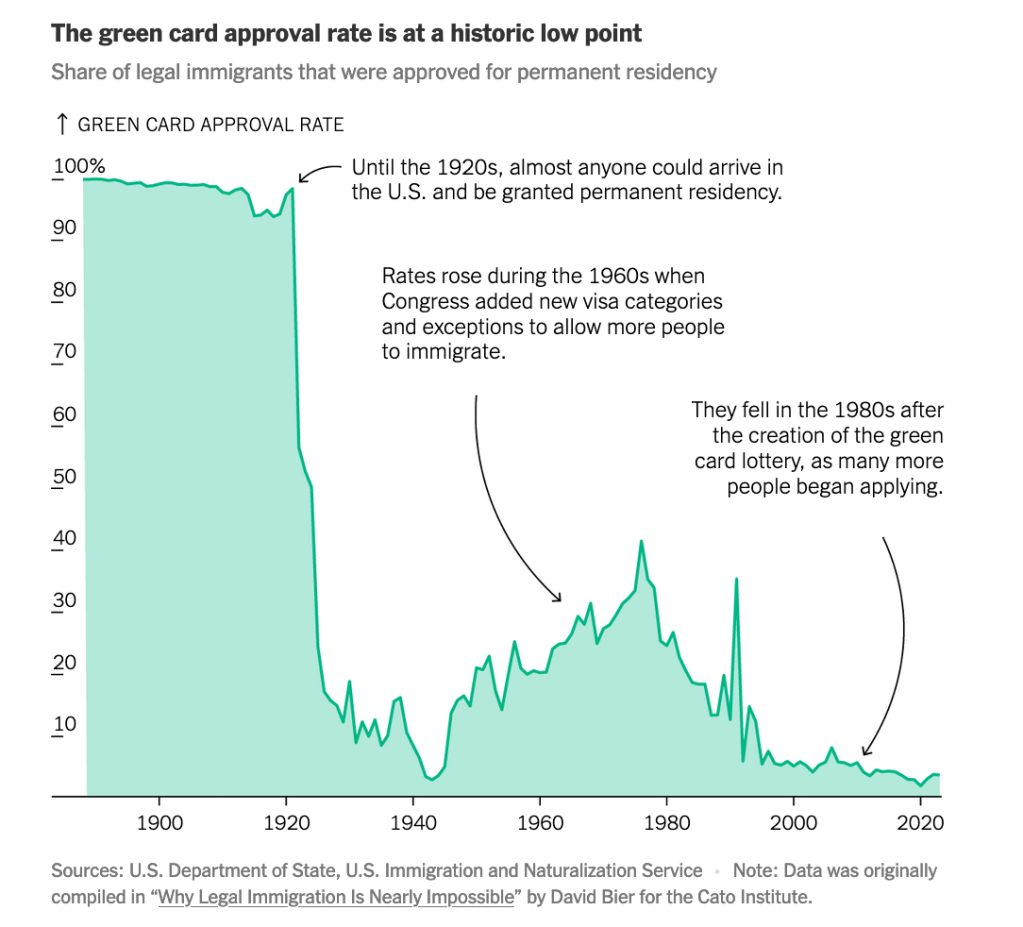
The US generally follows a family-based immigration system, the idea being that newcomers will find greater stability when they join other family members. Once here, US citizens and green-card holders are allowed to apply for immigrant visas for their family members. So, how it that working?
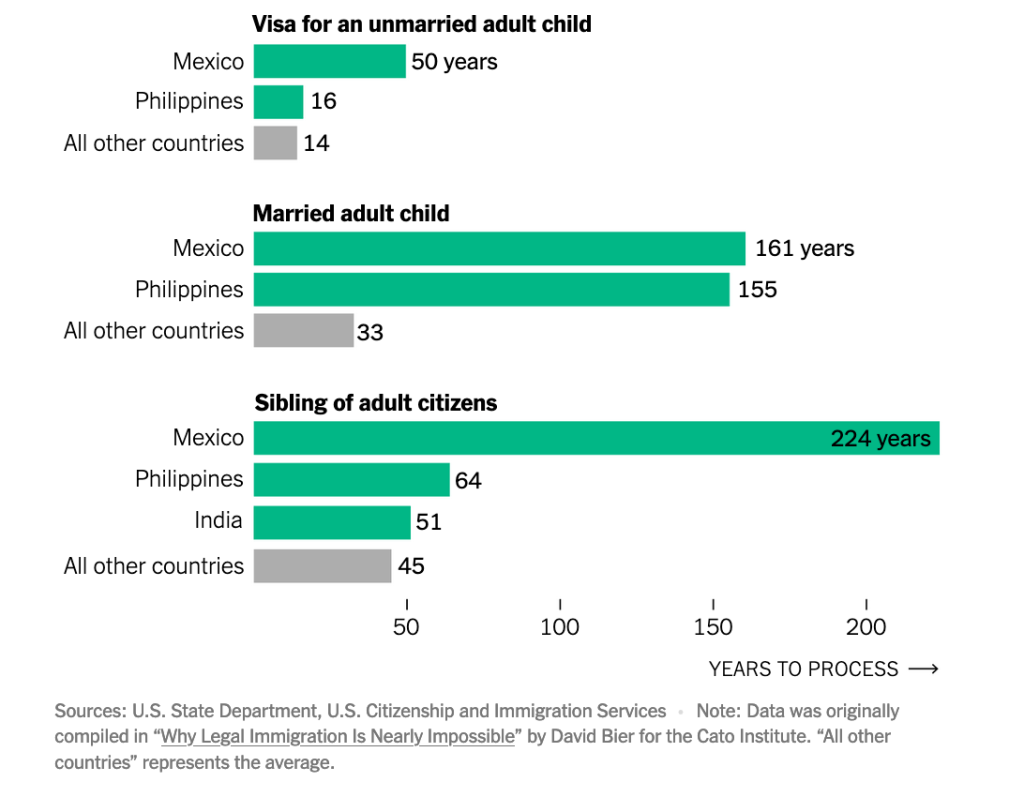
Consider the case of José, a US citizen who applied for a resident visa for his unmarried, 22-year-old, Mexican-citizen son. He’s in luck if he filed that application in 2004, more than 20 years ago, since consular officials in Ciudad Juárez (the only consulate in Mexico that handles requests for permanent immigrant visas) are currently arranging interviews for applications filed that year. But José would consider himself fortunate compared to someone who was about to file the same application today. The estimated wait time for a adult, unmarried child has gone up to 50 years. And God forbid if your child is married, for in that case you would have to wait 161 years. And José could expect to greet his Mexican brother for coffee in Los Angeles in 2248 – assuming it’s still there.
Why don’t immigrants just “stand in line” like my grandpa did? The answer is pretty obvious. The immigration system is utterly shattered. As one immigration lawyer recently wrote me, there are currently some “4 million removal cases now pending in front of 650 Immigration Judges.” If each case were a sheet of paper, the stack would be “almost the height of the Empire State Building.” Back in 2021, Judge Dana Leigh Marks said, “In essence, we are holding death penalty cases in a traffic court setting.” And that was when there were only 1.5 million pending cases.
The logical way answer to this crisis is to revise the immigration system, building a humane process that respects asylum rights and expands the availability of residential visas given the demographic and employment needs of the country. An immigration system where cases can be heard promptly and where “standing in line” can deliver a reasonable and timely outcome.
Of course, the argument that the most logical way to address “illegal” immigration is by expanding legal paths into the country is valid only if you think the US should be attracting immigrants in the first place, a proposition that Trump and his Republican base, as well as a majority of Americans, dispute. So let’s see why, and suggest how one can address the misconceptions and deceits that underlie such beliefs.
*Immigrants are “are stone-cold killers. They’ll walk into your kitchen, they’ll cut your throat.” They are criminals “at the highest levels.”
Whether immigrant or native-born, we can agree that those who commit crimes should be prosecuted under the laws we have. And, with the highest incarceration rate of any independent democracy on earth, we’re pretty good at that. But contrary to what Trump’s supporters think, violent crime has reached close to a 50-year low at precisely the same time that immigration has hit its highest level in decades. In 1980, immigrants made up 6.2% of the U.S.; by 2022 immigrants accounted for almost 14% of the population, and yet, the crime rate dropped by more than 60% over the same period.

Countless studies have shown that immigrants (both permanent residents and undocumented) are less likely than native-born Americans to commit crimes. One representative study from Texas found that “undocumented immigrants are arrested at less than half the rate of native-born U.S. citizens for violent and drug crimes.” So here’s a thought: Since immigrants are less likely than native-born Americans to commit crimes, we should be encouraging more immigration as one way to fight crime!
We hear stories of immigrants who commit crimes; and some certainly do. What we don’t hear often are the stories of immigrants who are crime victims – and there are a lot of those. Take the case of Pedro Carias, an undocumented Honduran construction worker who has been living in Fort Myers, Florida, for the past three years. After Hurricane Ian hit in 2022, a resident hired him to repair his home. Carias finished the work, but when he went to collect his payment, the homeowner pulled out a gun and threatened to report him to immigration officials if he didn’t leave immediately. The fact that undocumented immigrants can be threatened with disclosure by literally anyone both makes them handy targets for those who would take advantage of them and makes them much less likely to commit crimes themselves.
*Immigrants are stealing our jobs!
Are immigrants “stealing” jobs from US workers? This is a key element of Trump’s scarcity approach. Since, he implies, there are only a limited number of jobs to go around, any job an immigrant is hired for means one less job for an “American” worker. But the economy is not a zero-sum game. Employing one person doesn’t mean there is one less job for somebody else.
The labor market is clearly generating strong job opportunities for U.S.-born workers while also absorbing large numbers of immigrants. The unemployment rate for 2023 was the lowest on record, and the share of US-born workers is at its highest rate in more than two decades, at the same moment that immigration reached a high point. So, no, immigrants aren’t taking your job. In fact, most of the decline in native-born workers in the work force can be attributed to retiring baby boomers.
The removal of an estimated 8.3 million undocumented workers, approximately 5% of the labor force, might not have a major long-term impact on the US economy. But it would be devastating in particular areas, as immigrants fill jobs that US-born workers have abandoned. They are over-represented in what economists call 3-D jobs: dirty, dangerous, and demanding. These are the jobs in construction, meat packing, mining and agriculture. Native-born workers are understandably reluctant to work these jobs if they can find better work elsewhere. When Georgia passed a law in 2011 requiring that employers verify the legal status of their workers, the outflow of immigrant laborers led to what the Georgia Agribusiness Council estimates would be a total loss of $1 billion stemming from spoiled and unpicked produce.
So here’s a question for those who argue that immigrants are “stealing our jobs”: Would you, or someone you know, want to work in a meat or poultry plant where an average of 27 workers a day suffer amputation or hospitalization? Pick lettuce in Florida where Gov. DeSantis made it illegal for cities and counties to require employers to give their workers water breaks? Put a roof on a house when it’s 110 degrees outside? Did you know that more than half the on-site dairy workers in the US are immigrants – they are the ones who walk through the dirt and dung of a dairy barn at 4:30 every morning so you can have milk in your cereal.

Who do you think is going to rebuild Florida and North Carolina after Hurricanes Helene and Milton once Trump has deported all the undocumented workers? What do you think will happen to the price of milk in Idaho or Wisconsin where nearly 90% of dairy workers are immigrants? What do you imagine will happen to price of food at the supermarket? Do you really think that US workers will soon be flocking to those great jobs cleaning hotel rooms or blowing leaves off your grass?
Why do we let such false stories of immigrants as job-stealers or criminals drown out the stories, for example, of the six immigrants who were killed when a cargo ship slammed into the Francis Scott Key bridge in Baltimore harbor? The stories we should be telling voters are about Maynor Yasir Suazo-Sandoval, a big-hearted Honduran who came to the US when he was 20 and whose death when he was hurled into Baltimore’s harbor left his teenage son and a 5-year-old daughter without a father. Or Miguel Angel Luna Gonzalez, 49, a father of three who came from El Salvador nearly 20 years ago and was an active member of CASA, a nonprofit immigrant advocacy organization.
These are the stories we need to be telling, about the immigrants who repair our roads in the middle of the night while the rest of us sleep.
*They’re destroying our economy!
Trump and Vance will tell you that the surge of immigration to the United States is destroying the economy. They won’t mention that the well-known Marxist organization, the Federal Reserve Bank of Dallas, has estimated that over the next decade, immigration will boost GDP by $8.9 trillion and federal tax revenues by $1.2 trillion, while lowering the deficit by $900 billion. They might overlook the fact that undocumented immigrant entrepreneurs generated $27.1 billion in total business income in 2022, or that 157,800 undocumented immigrant entrepreneurs provide essential goods and services in neighborhoods across the country.
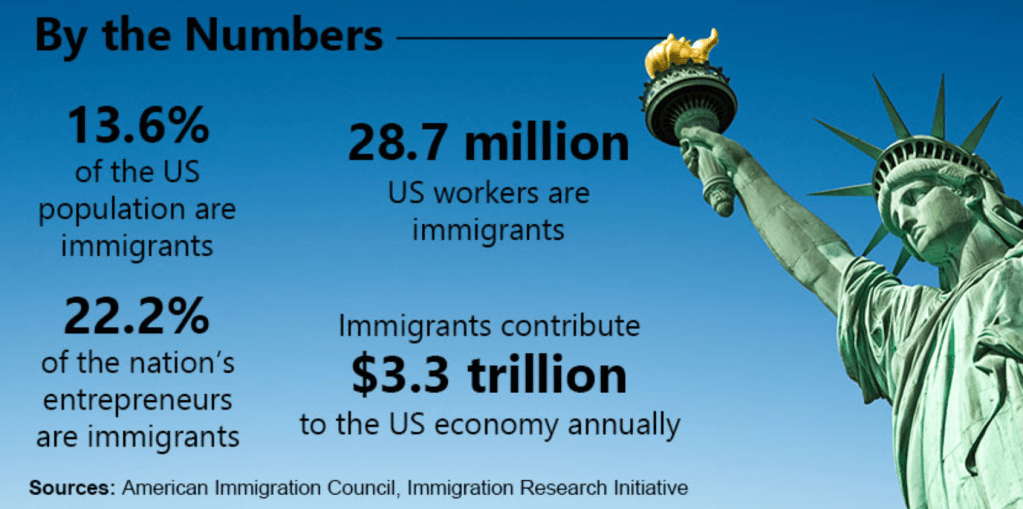
And please, don’t mention that deporting all undocumented immigrants would result in the loss of an estimated 4.2%-6.8% of GDP and more than $250 billion in purchasing power. Without continued high levels of immigration, according to the Dallas Fed, the US economy will “return to rates [of expansion] that are insufficient to sustain the type of economic growth the U.S. is accustomed to.” Why? Ohio is a good example: A new report by the Ohio Department of Development projects that by 2050, the state’s population will have fallen by about 675,000 people. Who will make up the short fall? Immigrants. Unless, of course, they’ve all been deported.
*They coming to take advantage of our benefits
Trump has been floating the idea of slotting Vivek Ramaswamy into his administration as homeland security secretary, the cabinet position which oversees immigration. Perhaps it’s because Ramaswamy has discovered why immigrants come to the US and, of course, how to stop them. “We need to man up and fix the root cause that draws migrants here in the first place,” he recently said, fingering “the welfare state” as the culprit. “But no one,” he continued, “seems to want to say that part out loud, because too many native-born Americans are addicted to it themselves.” Elon Musk quickly signaled his agreement.
Let’s repeat that: immigrants don’t come to the US to flee violence or droughts. They come for the lavish benefits that the government throws their way. But the real problem – you might casually slip this into your discussions with prospective voters — the real problem according to Vivek (net worth $1 billion) and Elon (net worth north of $247 billion), is that we, the native-born, have become “addicted” to things like Social Security and Medicare. We need “man up” and get over the preposterous idea that the government will be there to help us when we’re old and infirm.
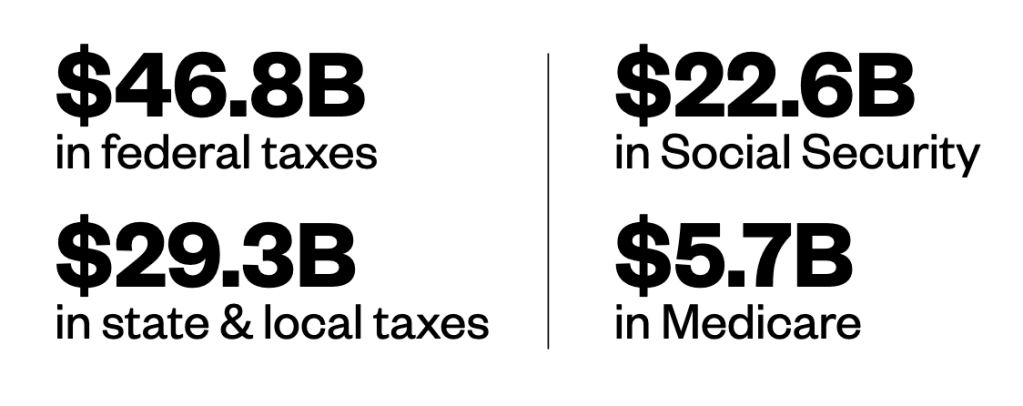
Besides the preposterous idea that a 20-year old Nicaraguan would risk his life coming here in order to collect social security when he turns 62, Ramaswamy seems to have forgotten that non-citizen immigrants are not eligible to receive most federal benefits. They must pay in when they work, but they get nothing back. In 2022 alone, undocumented immigrants paid almost $104 billion in taxes, nearly 3/4ths of which went to the federal government. In fact, undocumented immigrants paid taxes at a higher rate than the top 1 percent of households in 40 states.
Besides the insanity of any notion that a 20-year old Nicaraguan would risk his life coming here in order to collect social security when he turns 62, Ramaswamy seems to have forgotten that non-citizen immigrants are not eligible to receive most federal benefits. They pay in but get nothing back. In 2022 alone, undocumented immigrants paid almost $104 billion in taxes, nearly 3/4ths of which went to the federal government. In fact, undocumented immigrants paid taxes at a higher rate than the top 1 percent of households in 40 states. (Did I mention that Tesla paid $0 in federal taxes between 2018 and 2022 on $4.4 billion in profits? Or that Musk came to the US from South Africa on a student visa but never enrolled in classes, instead working to build his business – an immigration violation. Strange that he doesn’t bring it up when railing against immigrants and “open borders” today.)
As long as we’re discussing who is actually fleecing our generous “welfare state,” you might consider that In his last year in office, Trump commuted the sentences of at least five people who collectively filed nearly $1.6 billion of fraudulent claims through Medicare or Medicaid. Judith Negron was one of those whose jail time was commuted by Trump. She had been sentenced to 35 years in prison in 2011 for having filed $205 million in fake Medicare claims. Trump commuted her sentence in February 2020. Later that year, he commuted the sentence of Philip Esformes, convicted in 2019 for what the Justice Department called the largest health care fraud scheme they ever brought, involving over $1.3 billion in false claims to Medicare and Medicaid. So who, we could ask, is actually addicted to taking advantage of the government’s generous benefits?
*They’re driving up the cost of housing!
JD Vance recently asserted that the “Twenty-five million illegal aliens competing with Americans for scarce homes is one of the most significant drivers of home prices in the country.” Again, no. Besides doubling the estimate of undocumented immigrants in the country, Vance’s argument doesn’t hold much water. Economists are largely agreed that undocumented migrants have played almost no role in driving up housing costs. The sub-prime mortgage crisis and the Great Recession which followed, along with the rise in interest rates (making homeowners reluctant to sell in order to buy smaller homes), the pandemic (encouraging those who work from home to buy larger homes), and restrictive zoning laws are much more central to rising housing costs.
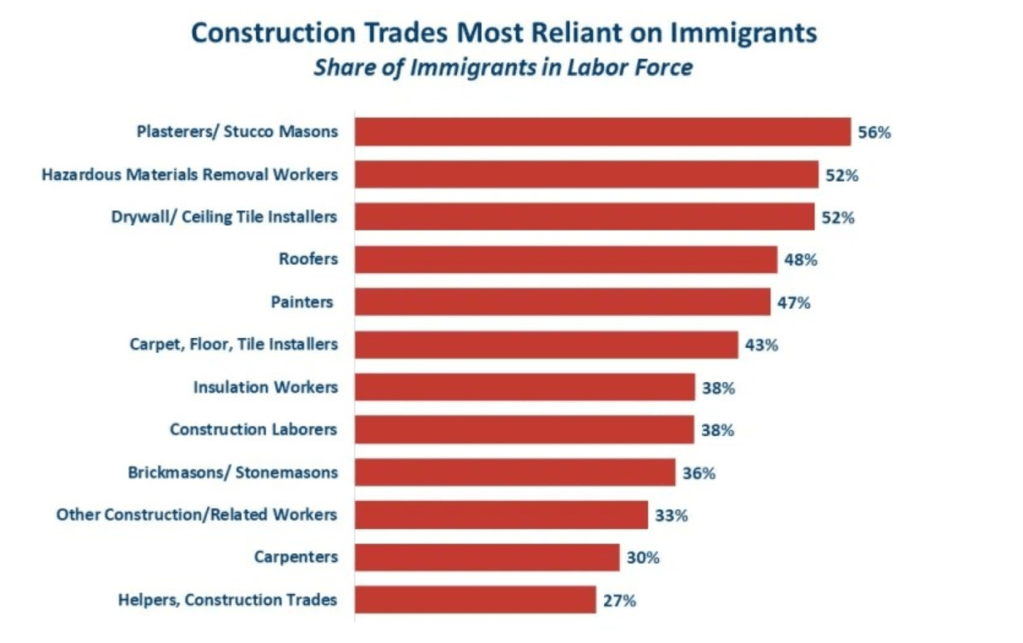
But what makes Vance’s charge dangerous as well as erroneous is that immigrants make up nearly one- third of the construction workforce, an industry which is currently still looking to fill 370,000 open positions, according to federal data. If you think there is a housing shortage now, imagine what it will look like when the US deports 30% of all construction workers?
*They’re stealing our elections!
Trump whined that he actually won the popular vote (and not just the electoral college vote) in 2016 once “you deduct the millions of people who voted illegally” for Clinton. More than half of the Republicans believe that illegal voters were responsible for his loss In 2020 (so, of course, he didn’t lose). And pro-Trump legal battalions have already filed nearly 50 lawsuits across the country claiming, with little basis, that as many as 1.4 million voters are illegally registered to vote in 2024.
In the first place, non-citizens can’t – and don’t – vote in federal elections. One study of federal election fraud between 2000 and 2012 found only 263 cases, out of hundreds of millions of votes cast, involving ineligible voters casting a vote – and it’s not even clear that any were from ineligible immigrants.

A more recent study put the incident rate of all voter fraud incidents in the last few presidential elections at around 0.0003 percent of votes cast. And even here, the suspicious votes were most likely due to clerical errors or bad data matching practices. Florida’s election police, all riled up by Gov. DeSantis’ determination to find and prosecute those thousands and thousands of illegal immigrant voters created a special task force to do just that. It ended up charging 20 people (out of 13 million votes cast) with committing voter fraud – and, again, almost none were non-citizen immigrants. And here in Ohio, Republican Attorney General Dave Yost recently announced a total of 6 indictments for voter fraud involving votes cast from 2008 to 2020.
*Immigrants are Changing Our Culture! “They’re eating your pets!”
First things first: We know for a fact that Haitians in Springfield, Ohio, aren’t stealing people’s pets to serve for dinner. Not only have all the officials from the city manager to Governor DeWine called the charge a blatant lie, but even JD Vance admitted that he fabricated the story – which hasn’t stopped him (or Trump) from repeating it often. “Migrants,” Trump repeated on October 16, are “eating…things…that they’re not supposed to.”
Why have Trump and Vance latched onto this particular lie with such, well, dogged insistence? It is a signal that immigrants are not like “us”: they don’t look like us, they don’t talk like us, and they certainly don’t eat like us. (The narrative of “others” whose inferiority is determined, in part, by their consumption of the wrong food traces its hemispheric roots as far back as Christopher Columbus and the Spanish colonization of the Americas.)

Leaving the racism of the pet-eating charge to the side, how do we answer the accusation that immigrants are changing “our” culture. Well, in the first place, it’s true; new people change existing cultures, and they always have. Every immigrant group brings with them their traditional foodways, music, fashion, celebrations, language, and other cultural practices, from the Scots-Irish-English of 18th century Appalachia to today’s Yemeni community in Hamtramck, Michigan. So when someone says that immigrants are changing “our” culture, they should understand that “American” culture has always changed. From bagels to stir-fry, pizza to perogies, Frank Sinatra to Lady Gaga, Selena to Shakira, immigrants have always helped shape American culture. That, we can say, is exactly what makes it American culture.
Consider the county of Pikeville, Kentucky, which is part of Kentucky’s 5th Congressional District, the whitest district in the nation. Over the decades its population has grown to include those of Italian, Hungarian, Polish, Romanian, Albanian, and Greek heritage. Today, Pikeville’s residents can be found dining at El Azul Grande and Mi Hacienda, El Picante and El Burrito Loco, restaurants that are run by workers of Mexican heritage who, as Arlie Russell Hochschild writes in Stolen Pride: Loss, Shame, and the Rise of the Right, “form part of a quietly welcomed minority.” Until Trump or Vance come knocking.
Changing our culture? Yes, and most often for the better: I’ve rarely met people as generous as the immigrant families whom I’ve come to know in Oberlin. They may be poor in material wealth, but they offer what they can to those with even less. When I arrived at the home of one of the families some months ago, I was introduced to a young man I hadn’t met before. “This is Juan,” they said. “He just started working in a restaurant in town, but it doesn’t pay him enough to cover rent and food. So he comes here to eat.”
And finally, what can we say to those who share Trump’s most dehumanizing prejudices about immigrants: they are “poisoning our blood stream,” have “bad genes,” are “trash,” and “vile animals”?
My responses involve faith traditions, reason, patriotism, and history as entry points to longer discussions. To be sure, these responses will have no purchase in a quick back-and-forth of accusations and rebuttals.
Would you define yourself as being located within a faith tradition? The commandment to care for the stranger appears more times than any other in the Bible. The Quran and other Islamic teachings encourage hospitality and care for strangers, emphasizing the importance of treating all people with dignity and respect. The understanding that we are all God’s Children and carry a spark of the Divine within us is a foundational conviction shared by many of our religious traditions. Every person, my Jewish faith informs me, is a universe, and to argue that one’s citizenship should determine one’s membership in the human community is an affront to the very foundation of faith itself.
If not faith, than what about reason or patriotism? Perhaps the central philosophical claim of the Enlightenment was the assertion that what unites us as humans, indeed what makes us human, is our ability to reason. It is this understanding that underlies the Declaration of Independence’s bold affirmation — the first among those truths we hold “to be self-evident”– that we are “created equal” and endowed with certain inalienable Rights including “Life, Liberty and the pursuit of Happiness.” Look as you might, but nowhere in the Declaration does it affirm, as Stephen Miller recently stated, that “You have the right to want a country that is of, by and for Americans and only Americans.”
Finally, if neither faith, reason, nor patriotism can pry open a discussion, maybe history can. We know the horrific consequences of political actors who have claimed that they alone can save the country and who think that God has sent them for that purpose. We know all too well that the scapegoating and dehumanization of entire populations has been used to promote slavery, genocide, and the worst crimes against humanity. And we know that those who have dehumanized others as a springboard to their own power are always on the lookout for new targets to replace the ones they have already debased. Their loyalties, after all, are to themselves alone. No one else.
The work ahead
We have become so accustomed to swimming in the misconceptions, deceits and lies about immigrants and immigration that we no longer recognize the water around us. Pointing this out is not an easy task, but it is an essential one, both now and after November 5th. Amos Oz talked once about the choices someone watching a huge fire burn out of control could make. They could run away, leaving those who couldn’t run to perish; they could write angry letters to the editor, or even launch a demonstration, demanding that whoever was responsible for the fire should be punished. Or, he wrote, they could “Bring a bucket of water and throw it on the fire.” And, he continued: “if you don’t have a bucket, bring a glass, and if you don’t have a glass, use a teaspoon, everyone has a teaspoon. And yes, I know a teaspoon is little and the fire is huge but there are millions of us and each one of us has a teaspoon.”
So, grab your teaspoons. There’s a lot of work to be done.
 After Class