Mid-semester Evaluations

Steven Volk, October 7, 2013

Mid-semester evaluations are not required by college (or departmental, as far as I know) policy. But, precisely because they are formative in nature and tucked into an on-going course, they are a valuable way to make small changes to your course that can improve student learning and focus your teaching efforts. To be frank, measuring student learning (assessment) is still a work in progress although significant research is suggesting significant approaches. But I am sure that there are a number of things we do that actually get in the way of student learning … and the mid-semester evaluation is a fine tool to help you figure out if you should stop an approach that is proving problematic or change your game plan to encourage learning. Continue reading

Preparing for Student Stress

Steven Volk, September 2, 2013

We talk often about getting to know our students at the start of the semester, starting with learning their names. You likely know, for example, that your courses on Blackboard provide a photo of your registered students. Find “Course Tools,” and then “Student Roster.” At the very least you’ll know what they LOOKED like when the picture was taken (which might bear no resemblance to what they currently look like). Often faculty hand out index cards or small slips of paper asking students to mention one thing by which you, the faculty, can use to remember them: a kind of mnemonic device (Elizabeth loves Maine lobster). In small classes, you can have students interview each other for a few minutes and then the “interviewer” introduces the “interviewee” to the class.

There are also ways to learn about in-coming students in a broader, sociological, sense. I always enjoy the famous Beloit College “Mindset List”, which reflects the world view of new students. Some of my favorites for the incoming Class of 2017 (born in 1995): Eminem and LL Cool J could show up at parents’ weekend, and Gaga has never been baby talk. Continue reading

One Big Motrin

Steven Volk, March 10, 2013

We have been going through a difficult time. One of the signposts of that difficulty, for me at least, came when I hesitated after writing the very first word of this posting: we. I wasn’t about to put it in quotes, but I have been realizing just how tenuous that “we” has become.  I know I don’t speak for a “we,” nor can I say what that “we” is feeling. Neither am I willing to abandon the hope embodied in the we.

As an intellectual, one who works with words and ideas and attempts to make them relevant in an environment in which learning occurs, I turned to literature as offering a way into this conversation (and I hope it is a conversation). To Virginia Woolf, in particular, whose 1925 essay, “How to Read a Book,” I was recently reminded of in a lovely blog entry by Maria Popova.

“The only advice … that one person can give another about reading,” Woolf writes, “is to take no advice, to follow your own instincts, to use your own reason, to come to your own conclusions. If this is agreed between us, then I feel at the liberty to put forward a few ideas and suggestions because you will not allow them to fetter that independence which is the most important quality that a reader can possess.” [The essay is in the public domain .] Continue reading

Designing Classroom Spaces to Promote Active Teaching and Student Learning

Steven Volk, February 24, 2013

Whether stated or implied, a tight link exists between classroom design and learning theory. For planning reasons, we tend to organize our classrooms (leaving labs and studios out of the question for the moment) on the basis of class size. The largest spaces in Oberlin (King 106 and 306; West Lecture Hall, Craig, Hallock, Severance 108, Warner, etc.) are designed for large numbers of students; the King, Peters, Bibbins, Severance, and Science Center classrooms (e.g. K337) will hold 20-60 students; and the “seminar” rooms around campus are designed for less than 20 students. The pedagogical implication of this are unspoken: “linear” classrooms are designed around lecture or other presentations; “horizontal” classrooms allow for class discussion.
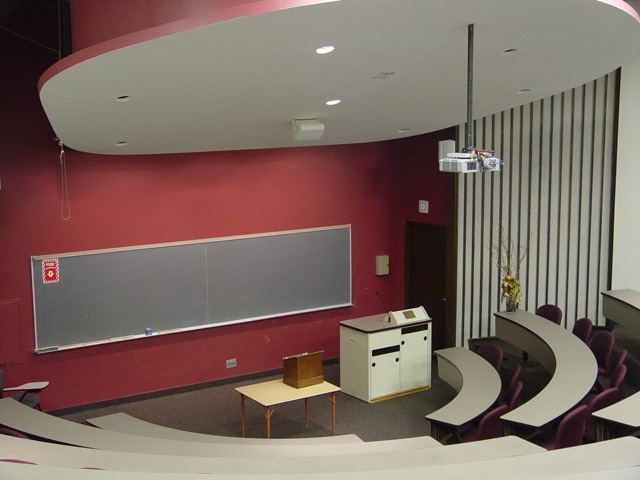
King106

King 106, Oberlin College

Many faculty engage in concerted guerrilla attempts to subvert the design of the classroom to which they are assigned: schlepping chairs from rows to circles; reconfiguring desks; allowing smaller groups to spill out into the hallways to find congenial discussion space. The large amphitheater spaces most deeply resist these seditious desires. I was defeated in my attempts to do anything other than lecture in King 306, although some faculty will have their students wheel around in their (fixed) seats to talk with those behind them; many will allow students to sit on the desks in a desperate attempt to promote discussion.

At the end of the day, though, we must admit that a large number of our classroom spaces were designed with student bodies, not student learning, in mind. They have been upgraded (at great cost and with much staff dedication and support) to provide access to technology, drapes have been changed, carpets added, desks swapped out. But a simple truth remains: except for the smaller seminar rooms, our classrooms are designed to have a “front” (from which point the teacher controls the technology console and the front black or white board/s), and faces out on the rows of chairs. Even seminar rooms are hard to re-purpose to allow small group discussions.

SCenterA162

Nancy Dye Lecture Hall, Oberlin College

What we know about how students learn has been developing over the past generation. Based on the research findings of some influential studies [e.g. John D. Bransford, Ann L. Brown, and Rodney, R. Cocking, eds., How People Learn; John Seely Brown, “Growing Up Digital: How the Web Changes Work, Education, and the Ways People Learn,” Change (March/April 2000); Theodore J. Marchese, “The New Conversations about Learning Insights from Neuroscience and Anthropology, Cognitive Science and Work-Place Studies,” AAHE Conference on Assessment and Quality, Assessing Impact: Evidence and Actions (1997), etc.], we can say with some confidence that deeper learning experiences (i.e., those that are at the higher end of Bloom’s taxonomy) occur when learning is social, active, contextual, engaging, and student-owned (see Colleen Carmean and Jeremy Haefner, “Mind over Matter. Transforming Course Management Systems into Effective Learning Environments,” EDUCAUSE Review (Nov/Dec 2002), p. 29).

I have full confidence that Oberlin teachers will make the most out of the classroom geographies they are assigned to create a learning environment which can provide these experiences. But it is hard to be fighting our furniture all the time.

tiny-furniture

Lena Dunham (Oberlin ’08) – Tiny Furniture

As much as I try to make 100- and 200-level classes (from 20-50 students) student-centered, I often feel trapped behind the technology console: I’m a (supposed) “sage” who is quite consciously trying to get off the stage, but there I am, in front.  Further, what we know of “universal design,” is that design (whether of buildings, classrooms, or course instruction) should take everyone into account from the ground up, not “accommodate” to special needs. Our classrooms, as currently configured, don’t take our students’ different learning styles into account. Again, we do our best to “accommodate,” to make it work. But shouldn’t we be designing for student learning from the beginning?

The more I think about this, the more I wonder what it would be like to have a classroom that was capable of supporting what we know about how students learn. What if Oberlin faculty  had a fully flexible classroom space, with modular furniture (both chairs and tables on casters), and tables that could hold 6-7 students, that could be shifted easily to meet the demands of a particular class session, with decentralized computing and networking (where there were flat-screens in 3 of the room’s corners and white/black boards on at least three walls)? (Photos of two examples, from Brown and the University of Minnesota, Rochester, are below.)

Helpfully, researchers at Cal Poly San Luis Obispo tried just such an experiment to evaluate the impact of  a variety of factors in a classroom design on student learning and engagement. You can find the full results of the study (Stern Neill and Rebecca Etheridge, “Flexible Learning Spaces: The Integration of Pedagogy, Physical Design, and Instructional Technology”) as a pdf on the web or in Blackboard. They conclude that “student-centered approaches to learning require a physical space that adapts to learner demands. Using modular furniture and accessible information technology better supports alternative approaches to teaching and learning. As instruction moves toward co-creation of the learning experience, the flexible, networked classroom provides an appropriate physical setting. Investment in flexible learning space design supports students and faculty and reinforces institutional commitment to educational excellence”(p. 7).

So here’s what I propose: Select 3-4 classrooms around the campus (King, Peters, the Science Center and Bibbins) to be fitted with modular furniture, accessible information technology,  three-wall displays (flat screens and white/black boards). All faculty who are interested in more active, experimental pedagogy can request the rooms while (for the purpose of evaluation), they will also be assigned to other faculty. Enlist some of the faculty with good experience in experimental research design to modify the Cal Poly experiment to our own needs and environment, and then rigorously assess the impact of classroom design on student learning.

Let me know what you think and what other ideas you may have on this subject or ideas for changes on campus that can positively impact student learning.

Size Matters: How Much Reading to Assign (and other imponderables)

Steven Volk, September 24, 2012

One question that comes up often for beginning faculty, but reappears almost every year you plan a syllabus is: How much reading should we be assigning in our classes? Is there an amount that is so reduced that students will think that my course is a “gut” (do they still call it that?); is there an amount so large that its only purpose is to signal how hard the class is? Obviously, any answer will depend on the course, the topic, the placement in the syllabus, etc. Five pages of a physics article may take as much time to “read” (more on why this is in quotes later) as 100 pages of history or a 200-page novel…but maybe not. Hence we keep asking ourselves the question.

Higher Education seems to be beset by a lot of hand wringing these days, or at least that’s the case for pundits who write on trends in higher education. Some of this angst has been spurred by Richard Arum and Josipa Roksa’s Academically Adrift: Limited Learning on College Campuses (Chicago: University of Chicago Press), 2011 which argued, very briefly, that student aren’t learning what they should in college and much of this is due to the fact that they aren’t being challenged. Among other factors, students are not reading enough, they are not writing enough, they are not studying enough. The authors highlight as an example of this that 32% of students each semester do not take any courses with more than 40 pages of assigned reading per week. One of the concerns I have about Academically Adrift is that I don’t know exactly what to make of this. Should we be happy that nearly 70% of the students are reading more? Are the 32% of the “light-reading” courses in the sciences, math, poetry, creative writing, studio art, etc? And finally, for the purpose of this discussion, do we have any research to suggest that more is better? Continue reading

Rove and Responsibility

Steven Volk, September 26, 2010

How can we as teachers help our students think about contentious events on campus in a productive and useful fashion? I hope I’m not being totally naïve when I ask this question, because I do believe faculty have a serious responsibility to engage these issues. Not only are we members of this community with standing, but we carry a considerable amount of moral authority. Here, then, are some suggestions. If you have more, as well as contrary opinions, please post them to the blog or send them to me. Continue reading

Reading Student Evaluations

Steven Volk, February 7, 2010

By now, as you well know, there is a very large literature on student evaluations of teaching (SETs). A lot of the research points to the validity and reliability of these instruments in terms of measuring very specific areas of a student’s experience in a completed class. Some writers continue to argue that they are a worthless exercise, citing evidence that evaluations handed out after the first day of a class will yield strikingly similar results to surveys conducted at the end of the semester, that they are a measure of the entertainment-value of a class, not any value added in terms of student learning, or that they can be easily influenced (just hand out doughnuts with the questionnaires). I have come to accept three basic realities about the use of SETs: (1) on a broad level, they help to identify outliers – a class which seems to have been extremely successful or highly troubled; (2) they should not be used as the only evaluation of teaching (peer evaluation and a study of course syllabi are strongly recommended as well); and (3) SETs are not a substitute for an assessment of student learning in a course. But, when read carefully, they can tell you something about your teaching on a very specific level. The question is how to read them to get that information out, and on that score, there is very little literature. So here’s a first attempt at this question, a kind of “SETs for Beginners.” Continue reading