No Kings

For many summers over more than a decade, I have had the pleasure of working with high school students attending the Great Books Summer Program. Great Books is a program for middle and high school students, devoted to an inquiry-based pedagogical model. Students engage in deep discussions of a set of texts selected by the instructor to guide them through a topic, subject or problem of our own design. Last year, for example, I taught two courses at the program’s Stanford campus: “From Harm to Repair” with readings ranging from Seneca and Aeschylus to James Baldwin and Desmond Tutu, and “From Law to Justice” in which we discussed works by Whitman, Camus, Ha Jin, Shakespeare, and Frederick Douglass, among others.

This year, I am inaugurating the program’s Scottish venue at the University of Edinburgh. I struggled for a bit wondering how to merge the Highlands locale with my ongoing concern for the truly frightening moment we face in the United States.  I have given many “Know Your Rights” presentations since mid-January, and each one seems to require more information as Constitutional Amendments fall like so many novice ice-skaters, not simply ignored, but ridiculed by the government. Even if the freedoms and liberties boldly proclaimed in the Declaration of Independence and later enumerated in the U.S. Constitution are, for many, more accurately described in the words of the Rev. Dr. Martin Luther King Jr as “promissory notes,”, that is all the more reason to defend and extend them with all our strength and imagination.

Jonathan Groff as King George III in “Hamilton”

As a Latin American historian, I found hardly any time to devote to the study of my own country’s history, and what little I once knew about colonial America and the early republic has long since retired, as the poet Billy Collins delightfully wrote, “to the southern hemisphere of the brain/to a little fishing village where there are no phones.” I’ve tried to remedy this in my retirement years, attempting grapple with first century of the nation’s history and to understand, among much else, what Jefferson and the “founders” understood when they wrote of “self-evident” truths, or “unalienable Rights,” or the “pursuit of Happiness.”

It wasn’t long before I came upon a host of Scottish Enlightenment thinkers (Francis Hutcheson, Adam Ferguson, Adam Smith, David Hume, among others) whose ideas were important to, and perhaps shaped, how Jefferson and other early republican thinkers imagined the country they were writing into existence. And so, my course emerged: We would discuss the impact of the Scottish Enlightenment on the ideas expressed in the Declaration of Independence. (I should clarify that it’s way above my pay grade to engage in the hotly debated question of whether one can credit these Scottish philosophers as the “hidden authors” of the Declaration. I’m much more interested in exploring with my students what they meant when they wrote of “happiness” or “Nature’s God” while examining the tensions they acknowledged between individual and communitarian freedoms.)

Continue reading

Dancing Through the Darkness

On April 5, I gave a talk at the annual SEPA (Santa Elena Accompaniment Project) dinner in Oberlin. My talk was both inspired by the sermons of Rabbi Sharon Brous, the senior rabbi of IKAR, a nondenominational congregation in Los Angeles that my wife, daughter and I belong to, and “borrowed” in parts from her remarkable book, The Amen Effect: Ancient Wisdom to Mend Our Broken Hearts and World.

Some years ago, after ICE agents carted off five workers in a raid on a local Mexican restaurant, an Oberlin College student, a neighbor active in the Salvation Army, and I collaborated on writing a resolution to bring to City Council. Its intention was to establish as city policy a measure that would prevent police, fire, EMS, or any other city service from asking for the citizenship status of any person who required assistance. The proposed resolution would also prohibit city police from requesting training to prepare them to act as immigration enforcers – something known as 287(g) training. We discussed the matter with city officials and the police but, as a formal resolution, we needed the positive vote of city council. This meant bringing it up for the traditional three readings at City Council before a final vote was taken. Before the first reading, the session where we would introduce it for discussion, so many threats were phoned into the city – threats to me would come later — that the city installed a metal detector for the first time to check those entering the building. I presented the resolution, and it ultimately would pass and be implemented. That resolution, with a few updates since its initial 2008 introduction, is still in effect.

Anyway, sometime after that, I received an angry email from a sender whose name I didn’t recognize. The emailer said she was from Painesville and had driven all the way to Oberlin to express her fierce opposition to the resolution at that first City Council meeting – even though they measure had nothing to do with Painesville. She wrote me incensed that at the meeting,I had accused her of being a “bigamist.” I found that strange, since I didn’t know her and hadn’t the slightest clue (nor any concern) as to whether or not she was a “bigamist.” I soon realized she probably meant to say “bigot,” not “bigamist,” and it was indeed quite possible that I referred to those opposed to the resolution we were introducing as “bigots.”

Continue reading

If Not Now, When?

In a recent New Yorker article, Susan Glasser wondered “Why aren’t we in the streets?” As Trump — who now refers to himself as a “king” and toys with the idea of serving a third term in the White House — and his co-president Elon Musk rip through the government, mocking legal barriers, scolding allies, and shredding the lives of millions, we remain, Glasser laments, “quiescent.” Perhaps we have simply been “overwhelmed by the unimaginable becoming real,” as M. Gessen suggested.

While the abysmal cruelty of Trump’s attacks on immigrants and the trans community is intended to isolate and terrify those vulnerable communities, his campaign to dictate what can and cannot be taught in our nation’s schools threatens to reinforce the structures of white supremacy and undermine the very purpose of education itself.  

Consider the email recently sent by the Provost of the Naval Academy, Samara Firebaugh, to her faculty. In it she instructed faculty to comb through course materials to extirpate such offensive words as “diversity,” “minority,” “belonging,” “bias,” “representation,” and “oppression.” “Do not use materials,” she commanded, “that can be interpreted to assign blame to generalized groups for enduring social conditions, particularly discrimination or inequality… Do not employ readings or other materials that promote the concepts of ‘gender ideology,’ ‘divisive concepts,’ ‘race or sex stereotyping,’ and ‘race or sex scapegoating,’ including critical race theory, intersectionality, privilege, patriarchy or other such theories.”

Continue reading

Small Things Like These

Although the circular firing squads have already formed and are carrying out their appointed tasks, I, for one, feel it’s too early to get a firm grip on why Donald Trump was able to win not only the electoral college, with its historic roots sunk deep in the soil of slavery, but the popular vote as well. For those less inclined to wait, the culpable parties include Inflation, an economy measured by the cost of eggs rather than bridges built or the Dow Jones index, working class anger, racism, misogyny, the “deplorables,” the Gaza war, elitism, an electoral system marinating in cash – an estimated $16 billion was spent on the current presidential election alone, more than the GDP of 51 countries! – and the weak standing of a current president which was passed down to his successor, not to mention the Democratic Party or the Republican Party, take your pick.

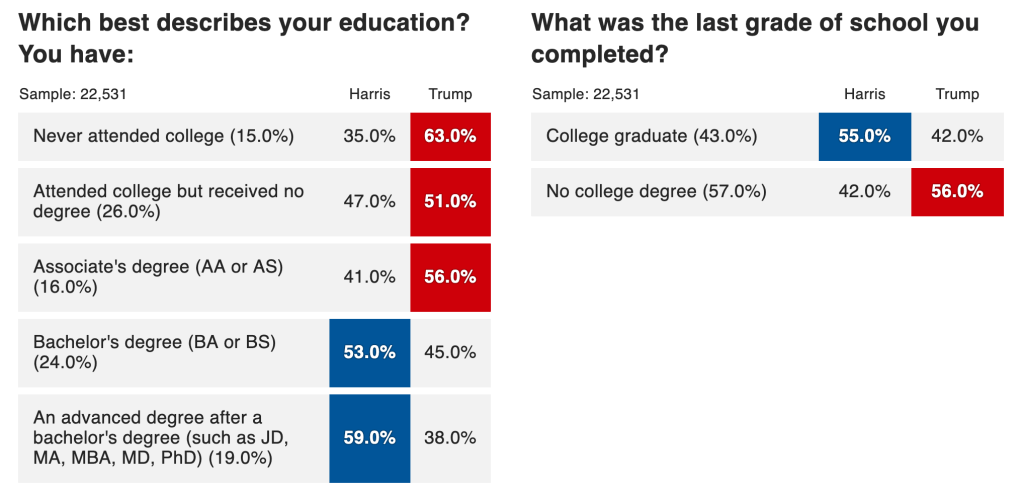
As I always have an eye out for the education sector, one factor stood out for me, yet again. Exit polling by both CBS and NBC revealed that educational achievement remains the most likely predictor of voting preference, having surpassed income levels some cycles ago.

Those of us in higher education have a lot to think and talk about in the months and years ahead.

For the moment, though, something else is on my mind. My wife and I went to see “Small Things Like These” over the weekend at a nearby cinema. Based on the spare novel by Claire Keegan, the film is set in Ireland in the 1980s. “Small Things” follows Bill Furlong (played by a magnificent Cillian Murphy), a man of few words and troubled memories, who delivers coal to the inhabitants of his small Irish town. Surrounded by his wife and their five girls, Furlong doesn’t drink, cares for his family, and works diligently at his back-breaking, monotonous job, He gets by, if barely, and generally without complaint. Still, he often lies awake in the middle of the night, staring out to the street and wondering “what was it all for?”

Continue reading

Immigration and the 2024 Election: Misconceptions, Deceits, and Bald-faced Lies

What follows is an extended and revised version of two talks I gave recently in Oberlin. Feel free to use any part of this, or the whole thing, in your own presentations, classes, blogs, or door-knocking opportunities.


As I write this, the election is fast approaching and for candidate Trump, immigration has displaced the economy as the “No. 1” issue. “That beats out the economy. That beats it all out to me, it’s not even close,” he concluded in mid-October. And, while more voters rank the economy and the high cost of living as their most important issue, 82% of Trump supporters and a whopping 61% of all voters put immigration as the most important challenge facing the country.

This is odd, one could even say weird. Whatever you think about immigration, it is unlikely to directly impact most lives, certainly not to the extent that, say, health care or education does. And immigration hardly represents an existential threat to the nation’s future (unless, of course, you think that America’s future rests in its enduring whiteness). If we wanted to talk about existential threats, we would be talking about climate change.

But immigration has become a serious issue for our future – not because of who immigrants are or how many are here, but because of how we as a nation have responded to them. A recent poll found that more than 60% of Republicans and nearly one-third of all Americans agree with Trump’s denunciation that immigrants are “poisoning the blood” of the country. Let’s repeat that: 3 out of every 5 Republicans are in agreement with one of the central underpinnings of both Nazism and white supremacy: the ideology of blood purity. The conviction that our blood contains not just cells and plasma but race, nationality, and “purity,” is a fiction that led to the murder of millions of Jews in Europe and the perpetuation of slavery and Jim Crow in America. Trump has introduced this abomination into his campaign, and, it appears, a considerable segment of US voters is buying it.

Continue reading

How to be Jewish: On Being Schooled by the House Committee on Education

At a time in which we all seem to have followed Alice through the looking glass, some comments from the most recent hearing of the House Committee on Education and the Workplace might not rank very high on our list of puzzlements. Certainly not as high as, say, MAGA followers describing Hunter Biden’s conviction on two felony counts as further proof that the rigged Justice Department was actively engaged in covering up the “true crimes” of the “Biden Crime Family.” But the comments caught my attention, nonetheless.

The committee hearings were the fourth set convened in the wake of the brutal October 7 Hamas attack on Israel and the support which some student organizations at Harvard had shown for the assault. In its first two hearings, Republican committee members had succeeded in humiliating the leaders of Harvard, Penn, and MIT, and in providing the president of Columbia a stage on which she could humiliate herself. Claiming that university presidents had allowed antisemitism to thrive on their campuses, Republicans charged the campus leaders with everything from a failure to provide Jewish students with a safe environment to maintaining silence in the face of a call for Jewish genocide. (At a third hearing, the superintendents of three liberal-leaning school districts in New York City, Berkeley, and Montgomery County, Maryland, successfully avoided the traps that had ensnared their university colleagues and demonstrated a much clearer sense of how to uphold their educational mission while also supporting their staff and students.)

Continue reading

Evaluating Teaching: Can We Get Beyond the Banality of SETs?

When I first began teaching in a tenure track position, my colleagues advised me that I had joined a department with a deep bench of knockout lecturers. One, I was told, could breeze through a detailed 50-minute lecture without once glancing at his notes (which he conspicuously placed on the lectern at the start of each class so as not to unsettle the students). The A-team’s lecturing prowess was reflected in the outstanding teaching evaluations they received (and is still vividly recounted by their 60- and 70-year old former students who return to campus for alumni weekend). If I wanted to garner equally stellar evaluations, it was impressed on me, I would have to step up my lecture game.

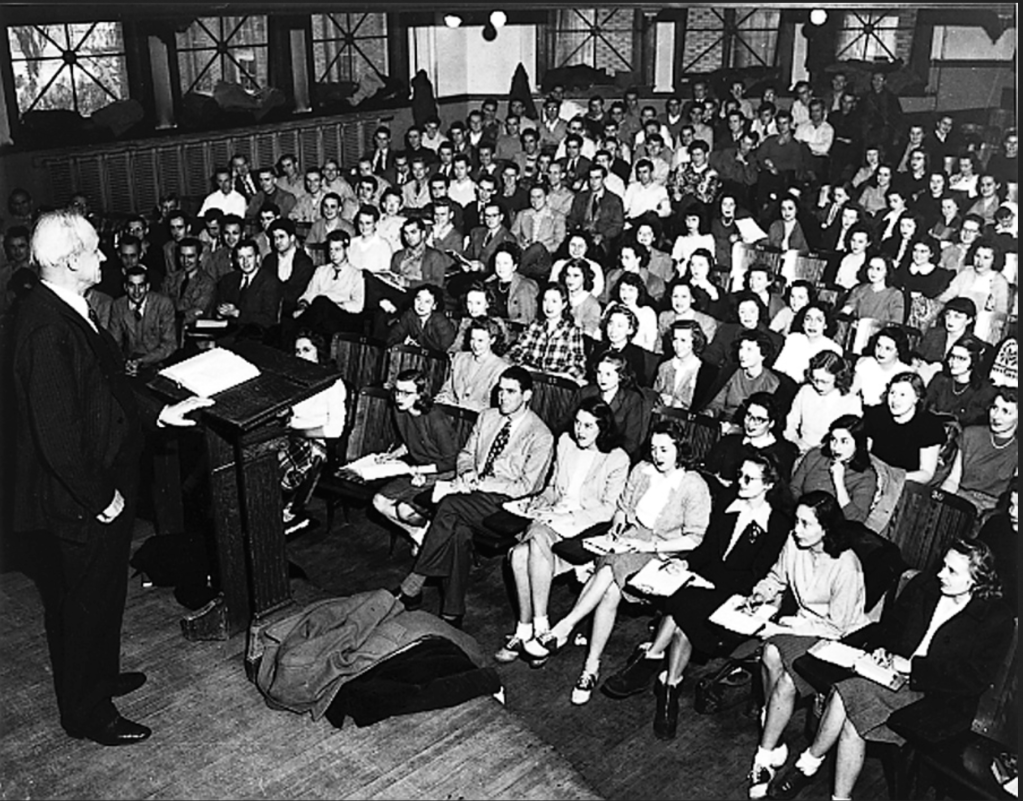
Economics Professor William H. Kiekhofer, lecturing in 1940 (Univ. of Wisconsin Archives).

I actually got pretty good at it – not to the level of memorization, but still good enough to boost my evaluations. All good, until it dawned on me that lectures could be inspirational, drawing students into the subject matter, but they weren’t the best way to promote student learning. And even the best lecture didn’t seem to capture the interest of those who purposefully occupied the back rows in my classes. My evaluations, while often good for my ego and, no doubt, helpful in my yearly evaluations, didn’t indicate whether any learning was taking place in class.

Encouraged by some reading in the scholarship of teaching and learning, greatly inspired by colleagues near and far, and (by then) protected by tenure, I moved away from lecturing in an effort to better address student learning. I had changed my classroom practice – but the evaluation process remained remarkably static, still using the same end-of-term questions to measure my effectiveness as a teacher.

Continue reading

Never Bring a Knife to a Gun Fight: Lessons from the December 5 Congressional Hearings

I have spent the better part of a month pondering what to make of the House Education and Workforce Committee’s December 5 public flogging of the presidents of Harvard, the University of Pennsylvania, and MIT. Much of the criticism heaped on the presidents’ heads after the hearings condemned them for being “evasive” when they should have been forceful, and for retreating into “context” and “lawyerly responses” when a “one-word answer” was in order. But, context actually matters – just ask Donald Trump’s lawyer, John Sauer, who couldn’t give a one-word answer when questioned by a federal appeals judge if a president would be immune from prosecution after ordering the assassination of a political rival. And context matters, as well, in terms of how we think about a reasoned response to the congressional thrashing to which the university leaders were subjected. Here, then, is a bit of my context.

I am Jewish. When Hamas attacked Israel on October 7, I did what many Jews did at that moment: feeling alone and vulnerable, I drew closer to my (literal and universal) Jewish family. Surprisingly, to me at least, I connected rapidly with the trauma that is a part of our history, the fear that is a part of our DNA, and a loneliness that I hadn’t thought about before. As the war expanded into Gaza, I also understood, as a Jew, our responsibility to never forget the humanity of all people, particularly given our own history of enslavement and oppression. This same ethical orientation has placed me on the political left where I have been for my entire adult life.

I am also an academic, not just in the professional sense of having spent most of my career teaching college students, but by observing, investigating, and critiquing higher ed during many of those years. In that examination, I have encountered much over the past few decades that has led me to worry that academia is losing its way. Beth Benedix, and I analyzed a number of the factors responsible for what we consider to be a crisis in liberal education in The Post Pandemic Liberal Arts College: A Manifesto for Reinvention.

Continue reading

Muzzling the Debate

Retirement offers many opportunities: sleeping later in the mornings (haven’t figured that one out); learning to paint (not really interested); becoming fluent in a new language (没有); streaming more television (Yes!). But in large part, being away from the daily demands of teaching has open the possibility of reading more deeply in fields of history that were outside my own.

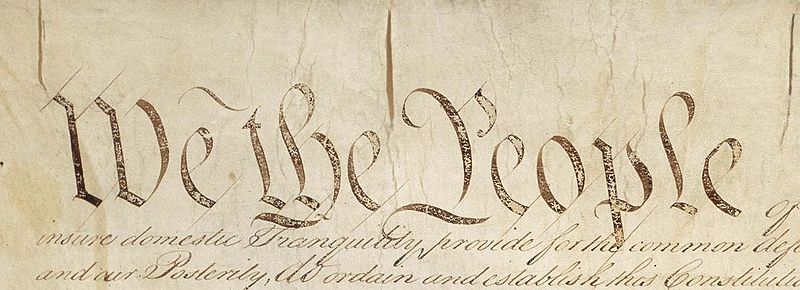
U.S. history has been at the top of that list, particularly the early republic, slavery, Black history, and Black struggles for equality and dignity. Ever since reading the 1619 Project a few years ago, I’ve tried to engage the historiographic debate about the shaping of the Constitution: was it “abolitionist” or “pro-slavery”? Sean Wilentz’s 2015 op-ed in the New York Times and David Waldstreicher’s response in The Atlantic nudged the debate over to non-specialists as well, and I followed the rolling, often heated, discussion in the pages of the New York Review of Books (see, for example, here and here), among other publications. That conversation, and a recent review by David Blight in the NYRB, encouraged me to pick up James Oakes’ The Crooked Path to Abolition: Abraham Lincoln and the Antislavery Constitution (Norton 2021).


Reading The Crooked Path led me to reflect, once again, on how historians think about contentious issues in the histories we explore. In the first place, I understand that I have not read deeply enough in the field to draw strong conclusions of my own on the central issue of whether the U.S. Constitution was “pro” or “anti” slavery, although I’m persuaded by Oakes’ superb book that it was both. Second, I found it affirming and energizing that historians who have been deeply immersed in the subject are not just capable of, but willing to modify their analysis in the face of more reasoned arguments and new evidence. As Blight observed: “We may be dead certain, or even mildly sure, about facts and the stories we tell about them, but our craft requires us to remain open to new persuasions, new truths.” Finally, and because of both points, I find it utterly infuriating that these rich debates will be shut out of classrooms in dozens of states because their instructors, quite simply, are forbidden by state law from raising them. Under the banner of opposing the “indoctrination” of students, hundreds of bills have been introduced to ensure that students will be prevented from grappling with the debates that shaped the nation’s history and continue to influence its evolution.

Continue reading

Ohio Races…to the Back of the Line

“Amid the tidal wave of proposals across the country that would eliminate diversity efforts at public colleges, Ohio’s Senate Bill 83 stands out.” That’s the lead to a recent article by Kate Marijolovic in the Chronicle of Higher Education. The American Historical Association warns that the Ohio bill’s “unwieldy omnibus of contradictory mandates would not only enable but even require classroom-level intervention by state officials.”

I’m sure that I’m not alone when I say that I’ve grown numb to the flood of Republican  attempts to tell students what they can’t study, administrators what they are not allowed to support, librarians what they are prohibited from putting on their shelves, women what parts of their anatomies they no longer control, the trans community who they are not permitted to be, LGBTQ+ young people what they must never talk about, Disney (Disney!) what the company can’t challenge

Just a hot minute ago, these same legislators were denouncing the Big Brother state for dictating what you could and couldn’t do. Remember the Right’s outrage when Michelle Obama encouraged food companies to market healthier food to children? “This is none of her business,” Rush Limbaugh puffed. “The free market takes care of this stuff…We believe in people having choice, to live their life as they choose. Coca-Cola, Twinkies, don’t kill anybody.”  And then there’s Representative Gary Palmer (R-Alabama) who, in response to the research linking gas stoves to pollutants that harm both human health and the environment, tweeted: “It is time to rein in the Biden administration and their continual desire to control American’s lives and decisions.”

The same folks who ridiculed “snowflake” students for not being able to handle the most trivial inconvenience without suffering a nervous breakdown, are now clutching their conservative pearls because school students might be “uncomfortable” were they to glance at the famous Norman Rockwell painting of Ruby Bridges being protected from an angry segregationist mob as she attempted to integrate an elementary school in New Orleans in 1960. A Tennessee law makes lesson plans illegal if students “feel discomfort, guilt, or anguish.” A proposed law in South Carolina prohibits teachers from discussing any topic that creates “discomfort, guilt or anguish” on the basis of political belief. And, of course, there’s Florida, where legislation forbids lessons that could cause individuals to experience discomfort, guilt or another form of “psychological distress” based on actions committed in the past by members of the same race, color, sex or national origin. The assumptions behind these prohibitions are dismaying, Imani Perry, Hughes-Rogers Professor of African American Studies at Princeton University, recently argued, as they presume that “white children won’t identify with Black people and people of color. It presumes cutting off the moral imagination of white children so that they can’t imagine themselves as being any kind of actor in history…We, none of us, are bound by our genealogy. We’re bound by our values.”

Continue reading