In a recent New Yorker article, Susan Glasser wondered “Why aren’t we in the streets?” As Trump — who now refers to himself as a “king” and toys with the idea of serving a third term in the White House — and his co-president Elon Musk rip through the government, mocking legal barriers, scolding allies, and shredding the lives of millions, we remain, Glasser laments, “quiescent.” Perhaps we have simply been “overwhelmed by the unimaginable becoming real,” as M. Gessen suggested.
While the abysmal cruelty of Trump’s attacks on immigrants and the trans community is intended to isolate and terrify those vulnerable communities, his campaign to dictate what can and cannot be taught in our nation’s schools threatens to reinforce the structures of white supremacy and undermine the very purpose of education itself.
Consider the email recently sent by the Provost of the Naval Academy, Samara Firebaugh, to her faculty. In it she instructed faculty to comb through course materials to extirpate such offensive words as “diversity,” “minority,” “belonging,” “bias,” “representation,” and “oppression.” “Do not use materials,” she commanded, “that can be interpreted to assign blame to generalized groups for enduring social conditions, particularly discrimination or inequality… Do not employ readings or other materials that promote the concepts of ‘gender ideology,’ ‘divisive concepts,’ ‘race or sex stereotyping,’ and ‘race or sex scapegoating,’ including critical race theory, intersectionality, privilege, patriarchy or other such theories.”
Although the circular firing squads have already formed and are carrying out their appointed tasks, I, for one, feel it’s too early to get a firm grip on why Donald Trump was able to win not only the electoral college, with its historic roots sunk deep in the soil of slavery, but the popular vote as well. For those less inclined to wait, the culpable parties include Inflation, an economy measured by the cost of eggs rather than bridges built or the Dow Jones index, working class anger, racism, misogyny, the “deplorables,” the Gaza war, elitism, an electoral system marinating in cash – an estimated $16 billion was spent on the current presidential election alone, more than the GDP of 51 countries! – and the weak standing of a current president which was passed down to his successor, not to mention the Democratic Party or the Republican Party, take your pick.
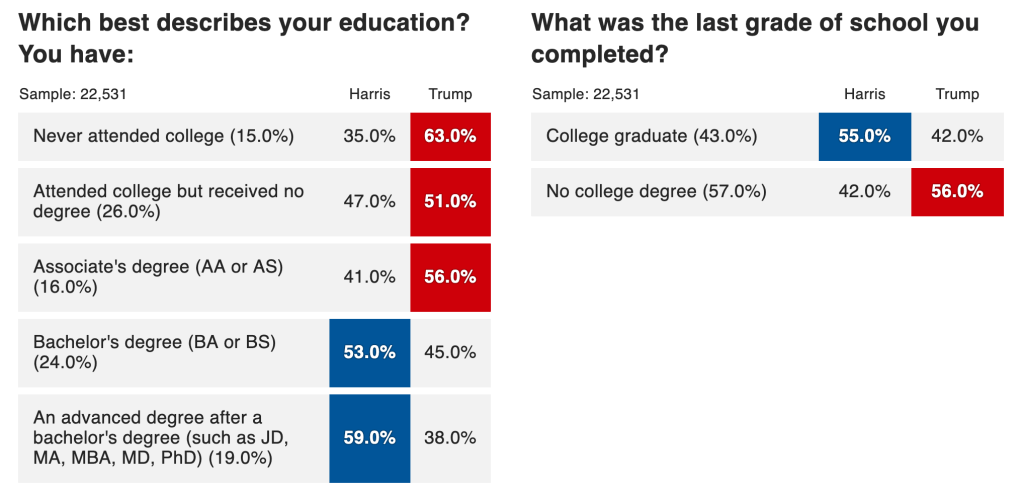
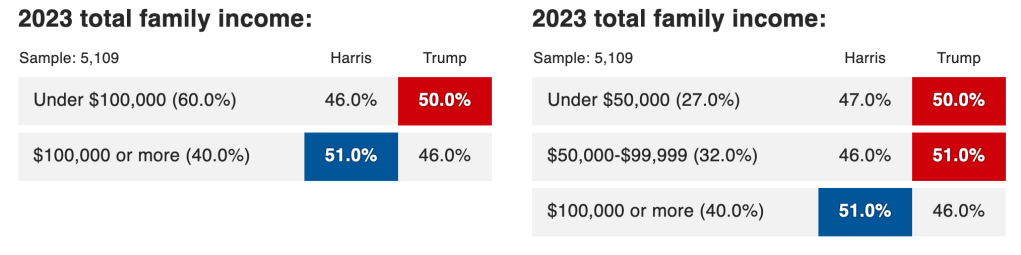
As I always have an eye out for the education sector, one factor stood out for me, yet again. Exit polling by both CBS and NBC revealed that educational achievement remains the most likely predictor of voting preference, having surpassed income levels some cycles ago.
Those of us in higher education have a lot to think and talk about in the months and years ahead.
For the moment, though, something else is on my mind. My wife and I went to see “Small Things Like These” over the weekend at a nearby cinema. Based on the spare novel by Claire Keegan, the film is set in Ireland in the 1980s. “Small Things” follows Bill Furlong (played by a magnificent Cillian Murphy), a man of few words and troubled memories, who delivers coal to the inhabitants of his small Irish town. Surrounded by his wife and their five girls, Furlong doesn’t drink, cares for his family, and works diligently at his back-breaking, monotonous job, He gets by, if barely, and generally without complaint. Still, he often lies awake in the middle of the night, staring out to the street and wondering “what was it all for?”
When I first began teaching in a tenure track position, my colleagues advised me that I had joined a department with a deep bench of knockout lecturers. One, I was told, could breeze through a detailed 50-minute lecture without once glancing at his notes (which he conspicuously placed on the lectern at the start of each class so as not to unsettle the students). The A-team’s lecturing prowess was reflected in the outstanding teaching evaluations they received (and is still vividly recounted by their 60- and 70-year old former students who return to campus for alumni weekend). If I wanted to garner equally stellar evaluations, it was impressed on me, I would have to step up my lecture game.
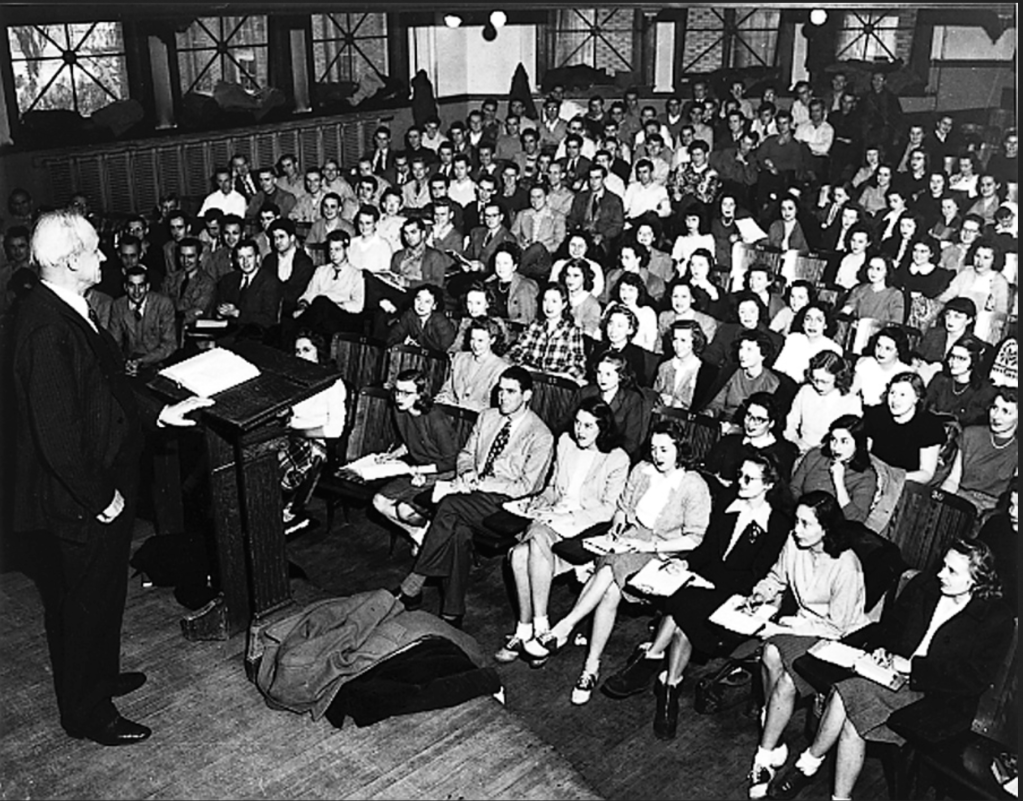
Economics Professor William H. Kiekhofer, lecturing in 1940 (Univ. of Wisconsin Archives).
I actually got pretty good at it – not to the level of memorization, but still good enough to boost my evaluations. All good, until it dawned on me that lectures could be inspirational, drawing students into the subject matter, but they weren’t the best way to promote student learning. And even the best lecture didn’t seem to capture the interest of those who purposefully occupied the back rows in my classes. My evaluations, while often good for my ego and, no doubt, helpful in my yearly evaluations, didn’t indicate whether any learning was taking place in class.
Encouraged by some reading in the scholarship of teaching and learning, greatly inspired by colleagues near and far, and (by then) protected by tenure, I moved away from lecturing in an effort to better address student learning. I had changed my classroom practice – but the evaluation process remained remarkably static, still using the same end-of-term questions to measure my effectiveness as a teacher.
In a radio interview on March 11, Wisconsin Senator Ron Johnson (R) said of those who stormed the Capitol on Jan. 6, killing five people, assaulting 125 Capitol police and injuring 70 of them in the process: “I knew those were people who love this country, that truly respect law enforcement, would never do anything to break the law, so I wasn’t concerned.” Not content to stop there, he pressed on, “had the tables been turned and President Trump won the election and tens of thousands of Black Lives Matter and antifa [sic], I might have been a little concerned.” Other than the unmistakable racism animating his statement, what Johnson has done is not just replace facts with fantasy, but remake reality to conform to his imagination. In his world, since the insurrectionists were respectful and law abiding, the violence is shifted to the “Black Lives Matter and antifa” protestors — who, of course, were only present in Johnson’s own counterfactual reality, which he is more than happy to share. Fintan O’Toole, a brilliant writer who reports regularly in the New York Review of Books, saw this coming. Former president Trump lied “prodigiously” and was able to successfully “obliterate for his supporters the distinction between the fake and the genuine,” O’Toole argues. But this alone couldn’t have created the strong bond which continues to glue his base to him. “What he managed to do,” he writes, “was simultaneously to erase the distinction between the valid and the bogus and to remake it…What is real is not what is going on. It is who ‘we’ are.” If “we” are peaceful, law abiding white people, than the insurrection couldn’t have been led by “us”!
I continue to ponder the role of higher education in responding to the epistemological and democratic crises on full display in Johnson’s interview which I considered in my last post. If the democratic crisis was most terrifyingly visible in the January 6 insurrection at the Capitol, an invasion bent on overturning a democratic election (and a Democratic victory), no less so is the epistemological crisis which paved it way by fashioning a “reality” in which two-thirds of Republicans think Biden’s victory was illegitimate and one-third say the claim that “Donald Trump has been secretly fighting a group of child sex traffickers that includes prominent Democrats and Hollywood elites” is either mostly or completely accurate. This is more than troubling even if, as a colleague who works on these issues pointed out, Republicans still represent less than 30% of registered voters.
If I seem obsessed by this topic, it is largely because, as I observed in earlier posts and as emerging data continues to indicate, education is increasingly becoming an important predictor of party preference, more so than income, and increasingly since 2016. “At the subgroup level,” David Shor, the head of data science at OpenLabs, a progressive nonprofit, argued recently, “Democrats gained somewhere between half a percent to one percent among non-college whites and roughly 7 percent among white college graduates.” That, he added, “is kind of crazy.” A voter’s level of educational attainment — whether they had a college degree — became even more predictive of which party they voted for in 2020 than it had been in 2016, while a voter’s racial identity became less predictive.
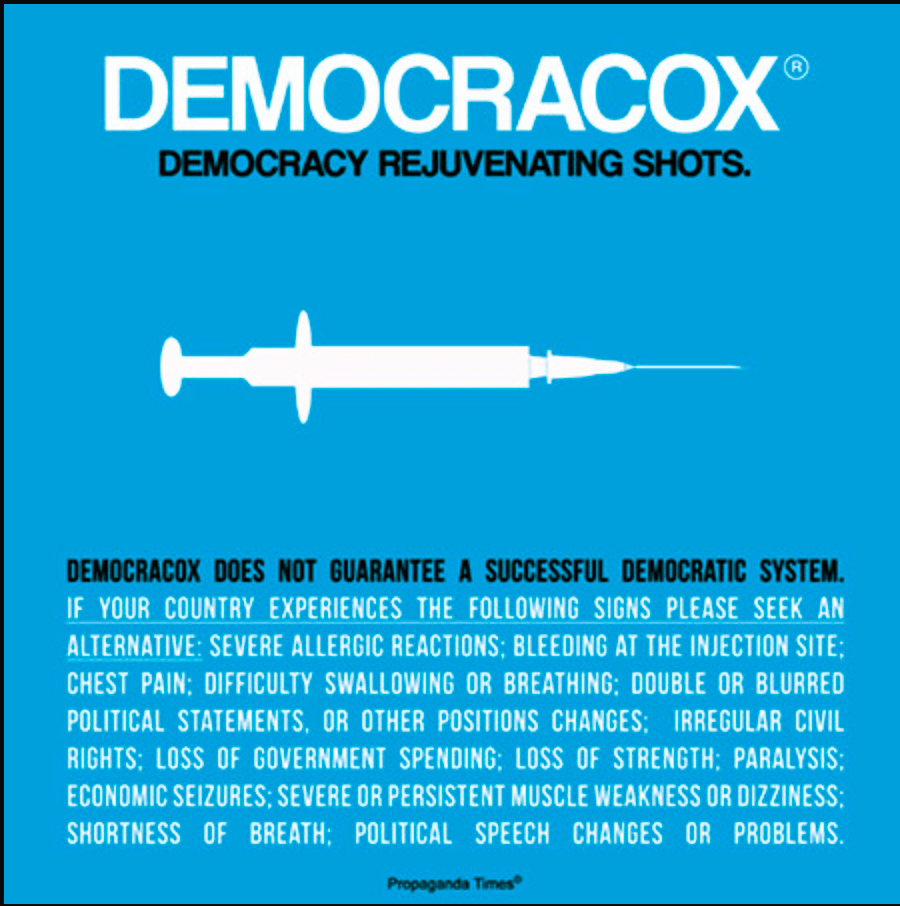
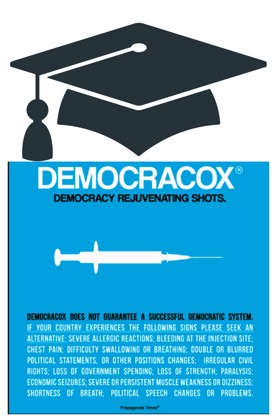
As the Republican Party sails deeper into anti-democratic waters, as it persists in lashing its future to an individual (and a remarkably flawed one, at that) rather than to any ideas or legislative program – see, among many others, here, here, here, and here – one begins to wonder whether a bachelor’s degree can offer some kind of immunity to the authoritarian virus. Yet even were this the case, the “vaccination” rate remains too low (less than 35% of persons 25-29 hold a bachelor’s degree) and the “efficacy rate” of today’s college education in preventing “smart” people from anti-democratic cravings is not robust (the margin between Trump and Biden voters with a college degree is actually quite narrow). By now we all are aware that Ted Cruz’s office is papered with his Princeton and Harvard diplomas, that Josh Hawley boasts degrees from Stanford and Yale, and that Louisiana Senator John Kennedy attended Vanderbilt, the University of Virginia, and Magdalen College (Oxford). Yet none of what they learned at those august institutions stopped them from attempting to halt a democratic election in a Senate vote taken a few short hours after insurrectionists roamed the Senate floor and rifled through their desks. Ninety-six percent of the members of the 116th Congress had a college education, two and a half times more than the population as a whole. Yet, according to Gallup polling from December 2020, when asked about honesty or ethical standards, only 8% of respondents rated members of Congress as “very high” or “high.” (And yes, If you’re wondering, that puts them at the bottom of the heap, even below the proverbial used car salesman.) The chasm between morality and intellect is not new, but it is troubling. We have agonized for decades trying to understand why learning and knowledge didn’t safeguard the Germans, well-educated students of Goethe and Kant and other humanistic giants, against murderous hatred. How is it that schooling (and higher education in particular) has become so alienated from ethics? Should we try to reverse that alienation? Can anything be done to reverse that movement?
It’s been a while. Some months have passed since I last posted to “After Class.” To those who have written wondering whether I’ve been stricken with COVID, fallen into a ditch, or just tired of writing: thanks for your concern. I’m fine, and actually have spent these last many months writing a book with my colleague, Beth Benedix of DePauw University. The Post-Pandemic Liberal Arts College: A Manifesto for Reinvention (Belt Publications) came out at the end of September. The book reaffirms our intense pride at having taught a (combined) half century in liberal arts colleges and seen generations of our students, regardless of their myriad career paths, remain engaged with their communities and devoted to what in Hebrew is called tikkun olam, repairing and making the world a better place. And, holy crap, is that ever needed now!
At the same time, we express our concern that, rather than taking advantage of their small size and residential nature, our colleges are replicating the departmental structures characteristic of much larger universities and holding fast to traditional pedagogies and curricula that do not adequately prepare students for the world they will enter. What is more, we have become increasingly frustrated by how these colleges, including our own, reproduce wider structures of economic exclusion and systemic racism. Although they are hardly alone in this, they have frequently become engines of inequality, using selectivity as a mask for elitism. Our “manifesto” suggests how, coming back from the COVID-19 pandemic, as we will, small liberal arts colleges should reimagine, reinvent, and redesign themselves to address these problems.
Why not with a definition of “post-truth” from the Oxford dictionary: “Relating to or denoting circumstances in which objective facts are less influential in shaping public opinion than appeals to emotion and personal belief.” Oxford has selected “post-truth” as its “word of the year,” narrowly besting “bigly.” (OK, that last part was my own rocket into the post-truthian universe.)
Or perhaps we should start with a New York Times headline from the December 7 edition:
From there, it’s but a quick hop to this clip from a CNN interview with a small group of Trump supporters on December 1. You’ve probably seen it, the one where Paula Johnson, a Trump enthusiast from New Hampshire, informed CNN’s Alisyn Camerota that at her (Johnson’s) polling station in Nashua, she caught people voting illegally who told her: “The president said I could vote, I’m here illegally.” Continue reading →


 After Class