If Not Now, When?

In a recent New Yorker article, Susan Glasser wondered “Why aren’t we in the streets?” As Trump — who now refers to himself as a “king” and toys with the idea of serving a third term in the White House — and his co-president Elon Musk rip through the government, mocking legal barriers, scolding allies, and shredding the lives of millions, we remain, Glasser laments, “quiescent.” Perhaps we have simply been “overwhelmed by the unimaginable becoming real,” as M. Gessen suggested.

While the abysmal cruelty of Trump’s attacks on immigrants and the trans community is intended to isolate and terrify those vulnerable communities, his campaign to dictate what can and cannot be taught in our nation’s schools threatens to reinforce the structures of white supremacy and undermine the very purpose of education itself.  

Consider the email recently sent by the Provost of the Naval Academy, Samara Firebaugh, to her faculty. In it she instructed faculty to comb through course materials to extirpate such offensive words as “diversity,” “minority,” “belonging,” “bias,” “representation,” and “oppression.” “Do not use materials,” she commanded, “that can be interpreted to assign blame to generalized groups for enduring social conditions, particularly discrimination or inequality… Do not employ readings or other materials that promote the concepts of ‘gender ideology,’ ‘divisive concepts,’ ‘race or sex stereotyping,’ and ‘race or sex scapegoating,’ including critical race theory, intersectionality, privilege, patriarchy or other such theories.”

Continue reading
Small Things Like These

Although the circular firing squads have already formed and are carrying out their appointed tasks, I, for one, feel it’s too early to get a firm grip on why Donald Trump was able to win not only the electoral college, with its historic roots sunk deep in the soil of slavery, but the popular vote as well. For those less inclined to wait, the culpable parties include Inflation, an economy measured by the cost of eggs rather than bridges built or the Dow Jones index, working class anger, racism, misogyny, the “deplorables,” the Gaza war, elitism, an electoral system marinating in cash – an estimated $16 billion was spent on the current presidential election alone, more than the GDP of 51 countries! – and the weak standing of a current president which was passed down to his successor, not to mention the Democratic Party or the Republican Party, take your pick.

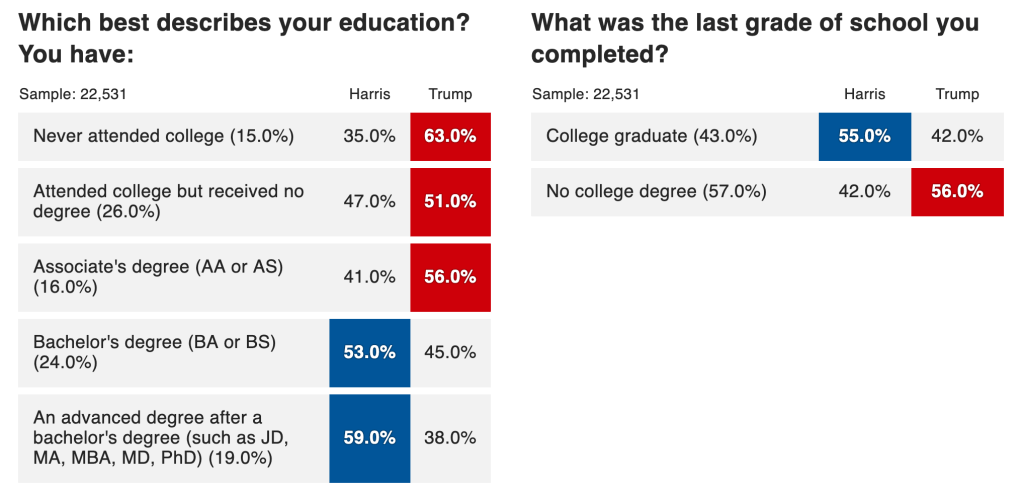
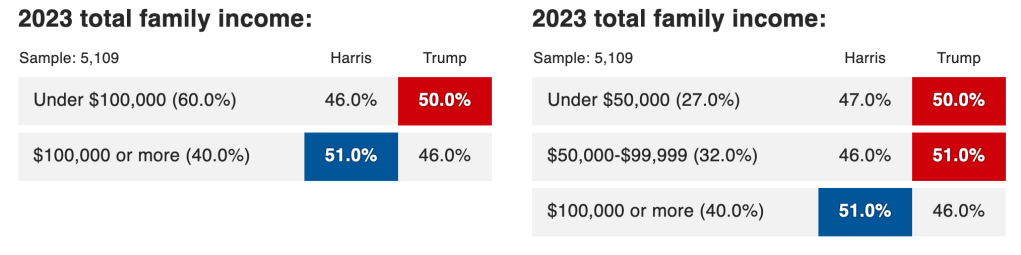
As I always have an eye out for the education sector, one factor stood out for me, yet again. Exit polling by both CBS and NBC revealed that educational achievement remains the most likely predictor of voting preference, having surpassed income levels some cycles ago.

Those of us in higher education have a lot to think and talk about in the months and years ahead.

For the moment, though, something else is on my mind. My wife and I went to see “Small Things Like These” over the weekend at a nearby cinema. Based on the spare novel by Claire Keegan, the film is set in Ireland in the 1980s. “Small Things” follows Bill Furlong (played by a magnificent Cillian Murphy), a man of few words and troubled memories, who delivers coal to the inhabitants of his small Irish town. Surrounded by his wife and their five girls, Furlong doesn’t drink, cares for his family, and works diligently at his back-breaking, monotonous job, He gets by, if barely, and generally without complaint. Still, he often lies awake in the middle of the night, staring out to the street and wondering “what was it all for?”

Continue reading

Ohio Races…to the Back of the Line

“Amid the tidal wave of proposals across the country that would eliminate diversity efforts at public colleges, Ohio’s Senate Bill 83 stands out.” That’s the lead to a recent article by Kate Marijolovic in the Chronicle of Higher Education. The American Historical Association warns that the Ohio bill’s “unwieldy omnibus of contradictory mandates would not only enable but even require classroom-level intervention by state officials.”

I’m sure that I’m not alone when I say that I’ve grown numb to the flood of Republican  attempts to tell students what they can’t study, administrators what they are not allowed to support, librarians what they are prohibited from putting on their shelves, women what parts of their anatomies they no longer control, the trans community who they are not permitted to be, LGBTQ+ young people what they must never talk about, Disney (Disney!) what the company can’t challenge

Just a hot minute ago, these same legislators were denouncing the Big Brother state for dictating what you could and couldn’t do. Remember the Right’s outrage when Michelle Obama encouraged food companies to market healthier food to children? “This is none of her business,” Rush Limbaugh puffed. “The free market takes care of this stuff…We believe in people having choice, to live their life as they choose. Coca-Cola, Twinkies, don’t kill anybody.”  And then there’s Representative Gary Palmer (R-Alabama) who, in response to the research linking gas stoves to pollutants that harm both human health and the environment, tweeted: “It is time to rein in the Biden administration and their continual desire to control American’s lives and decisions.”

The same folks who ridiculed “snowflake” students for not being able to handle the most trivial inconvenience without suffering a nervous breakdown, are now clutching their conservative pearls because school students might be “uncomfortable” were they to glance at the famous Norman Rockwell painting of Ruby Bridges being protected from an angry segregationist mob as she attempted to integrate an elementary school in New Orleans in 1960. A Tennessee law makes lesson plans illegal if students “feel discomfort, guilt, or anguish.” A proposed law in South Carolina prohibits teachers from discussing any topic that creates “discomfort, guilt or anguish” on the basis of political belief. And, of course, there’s Florida, where legislation forbids lessons that could cause individuals to experience discomfort, guilt or another form of “psychological distress” based on actions committed in the past by members of the same race, color, sex or national origin. The assumptions behind these prohibitions are dismaying, Imani Perry, Hughes-Rogers Professor of African American Studies at Princeton University, recently argued, as they presume that “white children won’t identify with Black people and people of color. It presumes cutting off the moral imagination of white children so that they can’t imagine themselves as being any kind of actor in history…We, none of us, are bound by our genealogy. We’re bound by our values.”

Continue reading

2017 – The Year in Higher Education

Steve Volk, January 22, 2018

It is stock-taking time; time to think about where  higher education stands one year after “45’s” inauguration, time to figure out how we as educators at liberal arts colleges have weathered what all agree was a very stormy year. Attempting to draw meaningful conclusions as to how our sector has been impacted by events in Washington, and how current developments will play out in the long run, or even next year, is challenging. But with this in mind, let’s look at the past year in higher ed, at where we stand on January 20, 2018 compared with January 20, 2017.

Attacking the Foundations: Alternative Facts and Fake News

When beginning to think about the year past, I recalled Antonio Gramsci’s often repeated remark about  “pessimism of the intellect, optimism of the will.”  The essence, the very heart, of what we do demands to some degree that we never abandon an optimism of the will. But it is fair to say that the year heaped yet more challenges on to higher ed’s already over-loaded plate. Perhaps the most serious challenge faced by educators came with the Administration’s on-going attack on facts, evidence, and truth. Two telling moments book-ended the year. The Trumpian year began, in case we’ve forgotten, when senior White House aide Kellyanne Conway defended on NBC’s Meet the Press, Press Secretary Sean Spicer’s claim that Trump’s inauguration two days earlier had drawn record numbers. This, despite all evidence, photographic included, to the contrary. What could have been ignored or laughed away instead became a cornerstone of the the new Administration’s approach to information when Conway defended Spicer’s assertion as “alternative facts.” (Within 4 days of her linguistic rebranding, sales of Orwell’s 1984 had jumped 9,500%.)

The year ended with Trump’s “highly anticipated” (ahem!) “Fake News Awards,” which were intended to blast the media by pointing to some of its miscues and factual errors, mistakes which are typically corrected and updated. As everyone knows, the “awards” were fundamentally about branding as “fake” any news that challenged Trump’s view of himself or the world and casting the media as an “enemy of the people.” Continue reading

Republicans to Mrs. Nelson: Drop Dead

Steve Volk, December 4, 2017

“What You Missed That Day You Were Absent from Fourth Grade”

by Brad Aaron Modlin
(reprinted from Krista Tippett’s “On Being”) 

Mrs. Nelson explained how to stand still and listen
to the wind, how to find meaning in pumping gas,

how peeling potatoes can be a form of prayer. She took
questions on how not to feel lost in the dark.

After lunch she distributed worksheets
that covered ways to remember your grandfather’s

voice. Then the class discussed falling asleep
without feeling you had forgotten to do something else—

something important—and how to believe
the house you wake in is your home. This prompted

Mrs. Nelson to draw a chalkboard diagram detailing
how to chant the Psalms during cigarette breaks,

and how not to squirm for sound when your own thoughts
are all you hear; also, that you have enough.

The English lesson was that I am
is a complete sentence.

And just before the afternoon bell, she made the math equation
look easy. The one that proves that hundreds of questions,

and feeling cold, and all those nights spent looking
for whatever it was you lost, and one person

add up to something.

Continue reading

Why Studying Sexually Dystopian Themes in 14th-century Epic Poetry Matters… and other thoughts on an education in the liberal arts

Steve Volk, January 16, 2017

Konrad von Altstetten embracing his lover. (Codex Manesse, UB Heidelberg, Cod. Pal. germ. 848, fol. 249v)

In Starving the Beast: The Battle to Disrupt and Reform America’s Public Universities, a film about higher education that came out late last summer, Frederick Hess, the director of education policy studies for the American Enterprise Institute, commented, “If somebody wants to write about sexually dystopian themes in 14th-century epic poetry, I think that’s fine.” But, he continued, “I have no earthly idea why taxpayers are supposed to subsidize this or subsidize students to learn it.”

Hess’s comments echoes the sentiment emerging from a considerable number of state houses lately, particularly as governors and state legislators feel emboldened to dictate what should and should not be studied at public universities and colleges in their states. Examples are not hard to find: Continue reading