If Not Now, When?

In a recent New Yorker article, Susan Glasser wondered “Why aren’t we in the streets?” As Trump — who now refers to himself as a “king” and toys with the idea of serving a third term in the White House — and his co-president Elon Musk rip through the government, mocking legal barriers, scolding allies, and shredding the lives of millions, we remain, Glasser laments, “quiescent.” Perhaps we have simply been “overwhelmed by the unimaginable becoming real,” as M. Gessen suggested.

While the abysmal cruelty of Trump’s attacks on immigrants and the trans community is intended to isolate and terrify those vulnerable communities, his campaign to dictate what can and cannot be taught in our nation’s schools threatens to reinforce the structures of white supremacy and undermine the very purpose of education itself.  

Consider the email recently sent by the Provost of the Naval Academy, Samara Firebaugh, to her faculty. In it she instructed faculty to comb through course materials to extirpate such offensive words as “diversity,” “minority,” “belonging,” “bias,” “representation,” and “oppression.” “Do not use materials,” she commanded, “that can be interpreted to assign blame to generalized groups for enduring social conditions, particularly discrimination or inequality… Do not employ readings or other materials that promote the concepts of ‘gender ideology,’ ‘divisive concepts,’ ‘race or sex stereotyping,’ and ‘race or sex scapegoating,’ including critical race theory, intersectionality, privilege, patriarchy or other such theories.”

Continue reading
Evaluating Teaching: Can We Get Beyond the Banality of SETs?

When I first began teaching in a tenure track position, my colleagues advised me that I had joined a department with a deep bench of knockout lecturers. One, I was told, could breeze through a detailed 50-minute lecture without once glancing at his notes (which he conspicuously placed on the lectern at the start of each class so as not to unsettle the students). The A-team’s lecturing prowess was reflected in the outstanding teaching evaluations they received (and is still vividly recounted by their 60- and 70-year old former students who return to campus for alumni weekend). If I wanted to garner equally stellar evaluations, it was impressed on me, I would have to step up my lecture game.

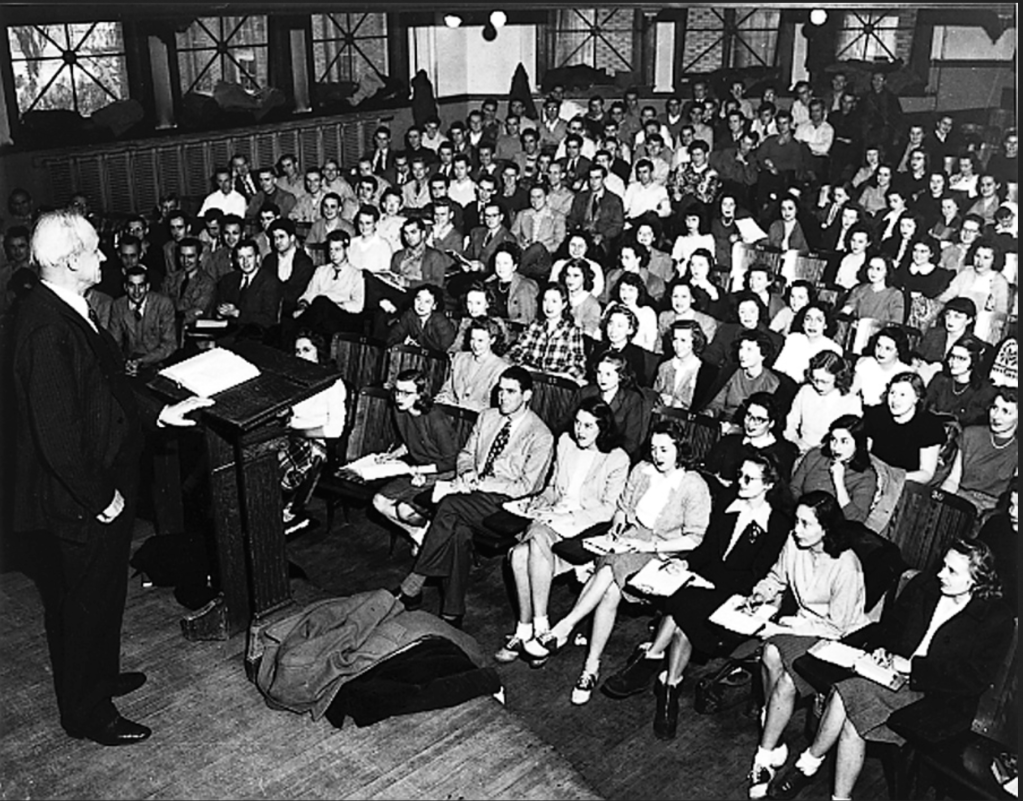
Economics Professor William H. Kiekhofer, lecturing in 1940 (Univ. of Wisconsin Archives).

I actually got pretty good at it – not to the level of memorization, but still good enough to boost my evaluations. All good, until it dawned on me that lectures could be inspirational, drawing students into the subject matter, but they weren’t the best way to promote student learning. And even the best lecture didn’t seem to capture the interest of those who purposefully occupied the back rows in my classes. My evaluations, while often good for my ego and, no doubt, helpful in my yearly evaluations, didn’t indicate whether any learning was taking place in class.

Encouraged by some reading in the scholarship of teaching and learning, greatly inspired by colleagues near and far, and (by then) protected by tenure, I moved away from lecturing in an effort to better address student learning. I had changed my classroom practice – but the evaluation process remained remarkably static, still using the same end-of-term questions to measure my effectiveness as a teacher.

Continue reading

The “Us” in Teaching

Steve Volk, October 31, 2016

"The Night School" (1873). The New York Public Library Digital Collections. 1873

“The Night School” (1873). The New York Public Library Digital Collections. 1873

The move to “disrupt” education usually focuses on replacing or at least supplementing face-to-face teaching with a remote instructor. Online teaching offers the promise (not the certainty) of a brilliant instructor orchestrating a well-crafted course that can reach thousands of students around the world. It is distance education, and if the reach of distance education has expanded impressively, the idea itself is hardly new. When I was growing up, I “attended” a distance education course via a television program called “Sunrise Semester.” My teacher, standing in a sparsely outfitted classroom studio in New York (I was in L.A.) endeavored to teach me algebra at 6:30 AM. The fact that I became a historian rather than a scientist provides some indication of how that turned out.

There’s a lot that can be said about the potential of distance learning, but much is sacrificed as well. By removing the teacher, what online learning disrupts is the personal interaction that has been at the heart of teaching and learning since, well, the beginning. Socrates and Plato, the Buddha and Trapusa.  Removing the physical presence of the teacher removes a vitality that is often at the core of what we are able to accomplish in the classroom. Continue reading

Teaching Tips for the New Semester

Steve Volk, August 22, 2016

Frank Boyd, "In Memory," Creative Commons Flickr

Frank Boyd, “In Memory,” Creative Commons Flickr

So I walked out to my driveway… and I couldn’t remember what I was there to do. Trash goes out Wednesday nights and it was Tuesday, so not that. Not to fix the flat on my bike, either; I forgot to pick up the patching kit in town. It won’t be until the next morning, in the shower, that I finally remember that I needed to ask my neighbor to feed the cats while we’re away.

Some years ago I shared with colleagues one of my favorite poems, “Forgetfulness,” by the marvelous Billy Collins. “Whatever it is you are struggling to remember,” he sighed, “it is not poised on the tip of your tongue/or even lurking in some obscure corner of your spleen.” How true. I’m at a point where I forget that we’ve already seen the movies on whose behalf I lobby enthusiastically to go see, or the mysteries I check out of the library only to (re)encounter their strangely familiar plots. This also happens with the timely advice that I’ve received over the years, advice that, Collins again, seems to have “retire[d] to the southern hemisphere of the brain,/to a little fishing village where there are no phones.”

And now I’m even forgetting the useful advice that I’ve given.

Assuming that maybe you have forgotten it as well, and as a way to bring faculty and staff new to the college into the loop, I’ve put together a “playlist” of past readings on pedagogy and classroom practice to refresh us all at the beginning of classes. Other advice (new and old) on evaluation and assessments, reflections and reconsiderations, will come later in the semester. Continue reading