[NOTE: This is the text of the keynote address I gave on April 25, to AMIS, an immigration advocacy group in northeast Ohio]
On a snowy evening some weeks ago, I shared the stage of the Stocker Center of Lorain County Community College with David Bier of the Cato Institute. We were there to discuss Trump’s immigration policies. Bier, like the Cato Institute that employs him, is a libertarian, dedicated to the “principles of individual liberty, limited government, free markets, and peace.” I’m all on board with peace and can’t argue against “liberty.” In fact, Bier and I found ourselves in general agreement that the Trump administration’s policies toward immigrants were not just cruel and xenophobic, but a self-inflicted injury to the country’s future. But, unsurprisingly, we also disagreed on many issues, and the questions posed by our moderator guided us to address what stood at the heart of our differences.
“Do we owe anything to immigrants?” the moderator asked. “Do we have any responsibility to or for them?”
Bier’s unambiguous answer was “no.” Not only do we not owe anything to immigrants, we don’t owe anybody anything. As independent agents, jealous of our individual liberties, we should largely be free from government regulations, unbound by any mandates that would require our responsibility to others. For example, we should be able to hire whomever we want regardless of their immigration status; we should be able to fire anyone we no longer want, unbound by government restrictions. That’s the essence of a free market, he argued.
I disagreed and, in a few words, tried to express why I found his answer so disturbing. The question of what we owe to others, of the responsibilities that we must assume lest our world become even nastier and more brutish than it already is, seems even more important today, immersed as we still are in yet another war of choice which has already cost thousands of lives and will upend the future for millions in the region and around the world. Trump proclaims his right to end a “whole civilization,” Hegseth celebrates death and destruction, Vance lectures the Pope on theology, yet no one in this administration shows the slightest concern for the human suffering we leave behind. Only this week we learned that the administration is giving the Afghans who helped US forces during its interminable war in that country a choice: either return to face the Taliban or be sent to the Democratic Republic of Congo. Like Tom and Daisy in F. Scott Fitgerald’s The Great Gatsby, we have become the “careless people” who smash up things and creatures only to retreat back into our vast wealth while letting others clean up the mess we have made.
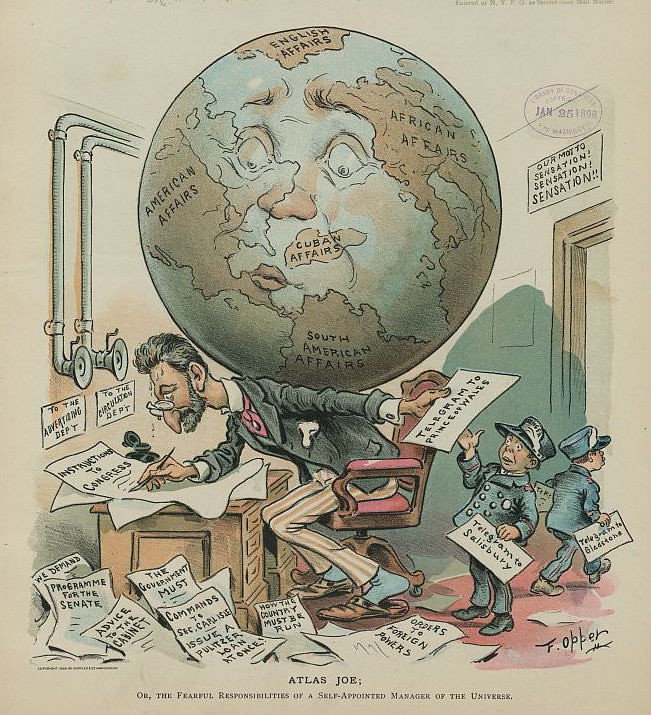
So the question of our responsibilities to others is urgent: What do we owe to others? What do we owe to the immigrants who share our land, help put food on our tables, and enrich our culture; what do we owe to those who came before us and to those who, hopefully, will come after? What do we owe to the earth and what is our responsibility for tikkun olam, for repairing the world? What is our obligation to act and to mobilize for change? What is our responsibility to keep hope alive? And what do we owe to the organizations that are doing the work of strengthening our communities and defending our immigrant neighbors?

“To whom does man in his priceless and unbridled freedom owe anything? […] To whom is he accountable?” These questions were posed by Abraham Joshua Heschel seven decades ago, and his response emphasizes that, contrary to a celebration of our autonomy, that our responsibility to others rests at the very foundation of what it means to be human, for as much as we may value our independence, we are never alone. “The dignity of human existence,” he stressed, is immersed in reciprocity. “To be a person is to reciprocate, to offer in return for what one receives. To be human is to be involved…to react, to wonder and to respond, to play a part in a cosmic drama.”
As the Buddhist scholar Joanna Macy put it, we are bound in a cosmology that recognizes interconnectedness both in how things work and in the moral sense of nonseparation, in the obligation to care for the whole. This should seem obvious, but when we see someone stepping up and selflessly taking responsibility for others, that act can take your breath away.
Some of you may have seen a video of Mandi Jung that came out of Minneapolis two months ago. Jung was testifying before the Minnesota Education Finance Committee at the height of the surge of the immigration enforcement actions that upended that city. In the video, we see her delivering her remarks in a steady voice, only occasionally showing the emotion that clearly churned beneath her calm surface. She speaks of Iván, one of her students. “Iván,” she says, “has been in hiding since January. He sends me emails asking me when he can come back to school. I tell him, I don’t know.” And then she continues, “I paid his family’s rent for January…$2,000. I don’t know who covered February.”

Did Mandi “owe” Iván’s family the money to cover their rent? Obviously not, but what her matter-of-fact disclosure revealed is an understanding that to be human is to be involved. “We are indebted to one another,” the philosopher, poet, and historian, Jennifer Michael Hecht wrote, “and the debt is a kind of faith — a beautiful, difficult, strange faith. We believe each other into being.” To each other, Mandi implicitly understood, we owe our existence.
“We may not survive while others drown,” the late British Rabbi Jonathan Sacks wrote. “We may not feast while others starve; we are not free when others are in servitude; we are not well when billions languish in disease and premature death…Men and women,” he added, “were made to serve one another, not just themselves.”

And so, yes, we have a responsibility to others. And to the stranger among us, we have a special responsibility. Our obligation to the immigrant was at the heart of a special message delivered last November by the U.S. Conference of Bishops “exhort[ing] nations to recognize the fundamental dignity of all persons, including immigrants. To our immigrant brothers and sisters,” the message continues, “we stand with you in your suffering, since, when one member suffers, all suffer.” The moral challenge of our time, Pope Francis had insisted, is how to expand the circle of people who “count,” building a wider “we,” un nosotros cada vez más grande, as he put it. Pope Leo has expressed his unshakable agreement multiple times.
In the Torah, we are reminded to treat the stranger fairly because “you know the feelings of a stranger, for you were strangers in the land of Egypt.” This counsel appears no less than 36 times, more than any other commandment in Scripture. Why, we can ask, so many times? Is it that we’re simply prone to forgetfulness and need to be reminded over and over? Perhaps… although some like Stephen Miller, who condemn immigrants as “invaders” who deserve deportation, not due process, could be reminded a billion times and yet still choose to ignore their own family’s history as they lash out at immigrants with a fury that speaks to some deep underlying psychological damage.
At the root of the need for these three-dozen prompts, I would argue, is not a matter of forgetfulness, but the challenge posed by empathy. The muscle of empathy required for us to fulfill these repeated commandments is not only a product of being able to picture ourselves as having been slaves in Egypt, a feat of great imaginative power, but the even greater imagination that’s needed for us to see ourselves as humans, yes humans, and therefore in community with all others, regardless of ethnicity or nation, means or race, language or customs. The challenge of this kind of imaginative empathy is so great that we must be reminded, again and again, 36 times, that the dignity we demand for ourselves, is the dignity that belongs to everyone.
On February 19 at 8:18 PM, Nurul Amin Shah Alám, a nearly-blind, non-English-speaking refugee from Myanmar, was dumped by Border Patrol agents in front of a Tim Horton’s donut shop in Buffalo. The temperature hovered just above freezing. Shah Alám had been in local police custody for five days on assault and weapons charges that arose after a short walk that had gone terribly wrong. He had set out for a local Burmese grocery store to buy some items including a curtain rod which he planned to use as a cane to steady himself as he strolled. Being nearly blind, however, he soon became disoriented and wandered into the backyard of Tracy Chicon, a white resident, as she was letting her dog out. She quickly called the police reporting “an unidentified Black man” in her driveway. When the police arrived, they ordered the 56-year-old, clearly confused man to drop his “weapon,” the curtain rod. But Shah Alám didn’t understand English, didn’t drop the curtain rod, and was arrested.
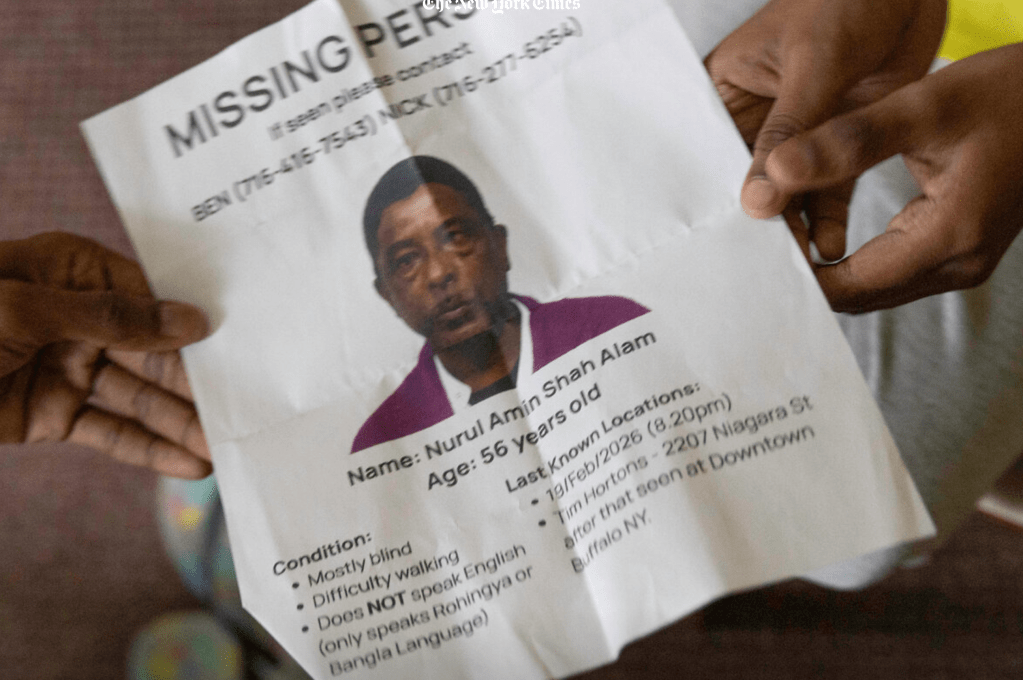
When the police finally released him five days later – God only knows why he was detained for so long – they alerted the Border Patrol whose agents picked him up the moment he left police custody. Aha! A criminal ripe for deportation, they thought. Clearly the “worst of the worst.” To their disappointment, they discovered that since he was legally in the country with refugee status, they couldn’t deport him. And yet, rather than notifying the desperate family members they knew were looking for him, they left him alone, in front of a closed shop, in the frigid dark. Shah Alám’s body was found five days later, and 4 miles away. Border Patrol felt they didn’t owe him anything; the police felt they didn’t owe him anything; Tracy Chicon didn’t owe him anything. None of them took responsibility for Mr. Shah Alam, whose death has since been ruled a homicide.
At that same moment, in front of Whipple, the federal building in Minneapolis where ICE set up shop during its Minnesota surge, Natalie Ehret waited in her minivan. She, and other members of Haven Watch, a newly formed group, were a near-constant presence at Whipple, where they waited, ready to give a coat, a phone, a hot cup of coffee, and a smile to those released from detention, both protesters and immigrants. When someone was released, a volunteer from Haven Watch wearing a brightly colored vest met them at the gate, took them to a warm vehicle, talked to them about what they went through and gave them what they needed to get back home.
Outside the Delaney Hall immigrant detention center in Newark, New Jersey, volunteers have created a hub of mutual aid for families deprived not only of loved ones, but often of their primary wage earners. They offer warmth, shelter, dignity and safety — a place for comfort and kind words, where families can connect, share their stories and affirm their shared humanity during an profoundly inhumane moment. After all, “to be a person is to reciprocate.” After all, we are our brothers’ keepers.
It is hard to square this sense of mutual responsibility and inter-connectedness which is deeply engrained in the world religions with a government that is currently rushing to spend $38 billion dollars on detention center warehouses – concentration camps, really – that can hold up to 10,000 detainees at a time. $38 billion when, for less than that, we could provide universal, all-day, high-quality pre-school for 3- and 4-year-olds for the entire country. It is hard to comprehend the depth of animus that must fuel a policy that currently has 60,000 immigrants in detention, more than 80% of whom have no criminal charges, for violating a civil misdemeanor charge equivalent to shoplifting – including an 85-year old French widow, the only licensed Hindi, Punjabi, and Urdu legal interpreter who has lived in Texas for 35 years, and more than 6,000 children. It is hard to imagine what we have become as a country when we commit $170 billion dollars over four years, a sum greater than the national budgets of Mexico or Sweden, to create what appears to be a personal army for the president to send out on whatever task he has in mind, whether to heed the call of a friend and benefactor who wants his ex-girlfriend deported, or to swarm through the streets of Minneapolis, Chicago, and Los Angeles and our own Cleveland Hopkins airport. As Detroit Archbishop Edward J. Weisenburger recently wrote: “I find myself asking if our nation is losing its very soul.”

In 1979, a 12-year long civil war began in El Salvador. Washington provided military aid and political support to a government that killed over 70,000 people, among them Archbishop Oscar Romero and four US church women, whose bodies were later found buried in unmarked graves.
In the 1980s, under the degenerate leadership of General Efraín Rios Montt, the Guatemalan military and their civic patrols murdered over 200,000 people, mostly Mayan peasant farmers. They, too, were supported by Washington.
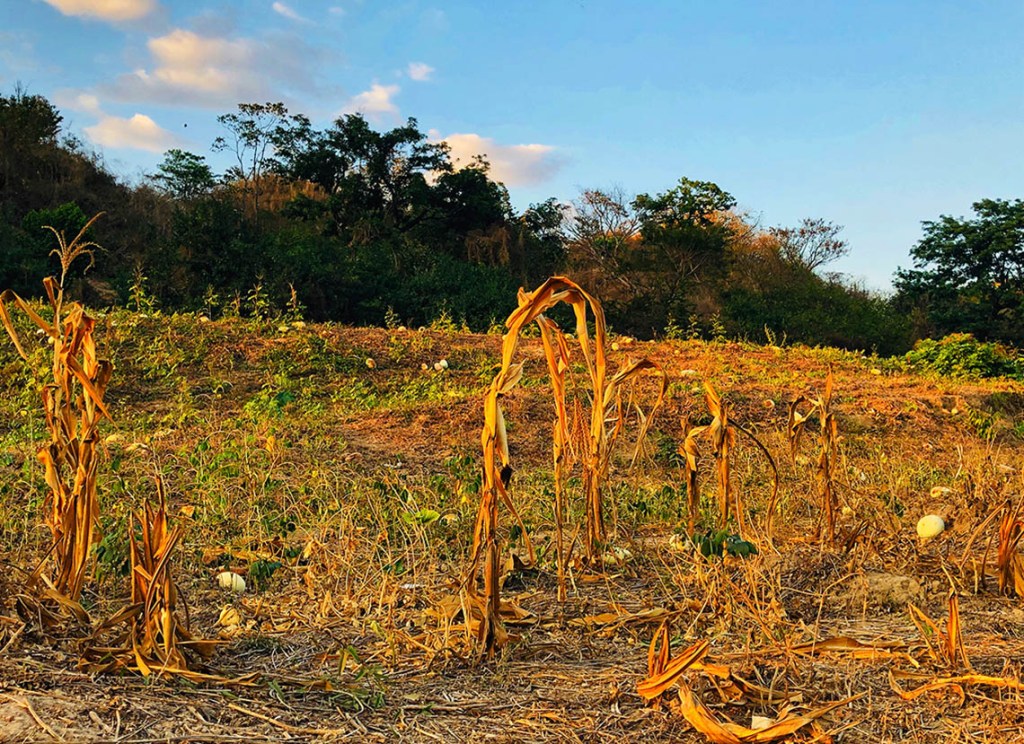
From the 1990’s on, Honduras suffered through a persistent drought, ranking as the second-most impacted country in the world in terms of the negative consequences of climate change. Drought decimated crop yields in the “Dry Corridor,” causing a near total loss of corn and bean harvests in some regions. The environmental disasters ravaging Honduran lands can be traced to the policies, practices and greenhouse gases coming out of the industrial North, primarily the United States.
In Mexico, violent drug cartels control towns, cities, and whole provinces, leaving death and mayhem behind. Perhaps a half-million people have been killed in the drug violence that has escalated since 2006. What fuels this violence? A seemingly unquenchable demand for drugs in the United States and a constant flow of high-powered weaponry into Mexico, about 75% of which comes from…the United States.
We should not be surprised, then, that literally millions of migrants have fled their countries to seek safety, security, and a home here because of what this country has done to them, to their homes and their countries. The vast majority of these migrants were not looking to leave. The thought of leaving mothers and fathers, grandmothers and grandfathers, perhaps never to see them again, perhaps never to be able to mourn by their gravesides when they were laid to rest, was – and is – immensely painful. To claim that we have no responsibility for them, that we owe them nothing, is to maliciously ignore what this country has done that made their journeys imperative in the first place.
“I still remember leaving Guatemala,” Alma Herrera-Pazmiño wrote when she was a junior in high school in San Francisco. “That day went by as quick as flipping a tortilla, I remember. I felt my stomach turning like it was a continuous carousel inside of a Ferris wheel. – Ay, qué náusea. My father just wants it to be better for us because he can’t provide if there aren’t any more jobs there, even though I had no problem with my life [in Guatemala]. There I was a jaguar, and Escuintla was my jungle, my playing field, my comfort. In America I feared I might just be a leg on a centipede and fall into the shadows of the nobodies. Every night I look at the moon, and I know my dad is looking at the same moon. It lets me know my dad is still coming…Not knowing English is a struggle. I am learning the language in school, but I can’t just go to the store yet because I don’t know what to ask for or what it’s even called. It’s hard. And it gets me frustrado, como si me quiero jalar los pelos de la cabeza, when I can’t say what I want in English. Soon enough I will be able to go to the store and ask for a coka without getting cheated out of my money. Soon I will accomplish my goal and help my mamá with groceries and answering the phone. This is what I will do to make my father proud. Little by little I’ll learn.”
Alma didn’t fuel the demand for drugs in the United States; she didn’t arm the cartels or create the conditions for the gangs that uprooted Salvadoran society. Alma didn’t dry out the fields of Honduras or place six-decades of sanctions on a country that has now been driven to the point of mass starvation. And yet it is Alma and others like her who are described as “vermin” by President Trump, disparaged for their lack of the proper “genetics.” It is Vice President Vance who says that we owe a “debt of gratitude” (his words) not to Alma, but to the Border Patrol agent who shot Renee Good in the face as she defended her immigrant neighbors. What Alma has and what our nation’s leaders lack, is right there in her name itself: a soul.

Because we “subsist in a web of mutual causal interaction[s], with no element or essence held to be immutable or autonomous,” we owe much to so many others. [Joanna Macy]
* We are born and destined to carry forward the chain of memory. As Trump and his followers seek, quite literally, to rip memory from the walls of our museums and the pages of our history books, the responsibility falls to us to preserve and honor the stories and histories of those who faced death and discrimination as they struggled to make this country live up to its promises.
* We have a responsibility to fight for a nation that is once again “dedicated to the proposition that all men are created equal,” as Lincoln put it after the horrifying Battle of Gettysburg, restating and reinforcing the Declaration of Independence.
* As the administration works to undo all efforts to safeguard the environment, the earth itself reminds us of our obligation to protect a future that is inextricably tied to the health and survival of life on our planet. “Its life is our life,” the Dalai Lama observed, “its future our future.”
* We have a responsibility to speak truth to power, as did Mandi Jung, whose inspiring testimony I referred to earlier. She reminded the senators sitting in front of her of the courage of the children who crossed deserts and waded through rivers with their parents “all to have the opportunity to sit in my class. I share my students’ stories to shame you,” she continued. “Shame on you for your silence; shame on you for your inaction; and shame on you for your cowardice.”
* Our responsibility to each other is a responsibility to act, protest, speak out, step up, organize, vote, repair and resist. “This seems an age of catastrophe,” the socialist geographer Mike Davis wrote, “but it is also an age equipped…will all the tools [we] need.” We have seen this in action on the streets of Minneapolis and Chicago, in Portland and Columbus. We have seen it reflected in the work of all those who are a part of ICE Watch patrols, who accompany immigrants to their hearings and doctors’ appointments, who are there with warm cups of coffee and a welcoming smile, who remain unintimidated by the government’s show of force.
* Finally, it is our responsibility to sustain, protect, and lift up organizations like AMIS, which are working beyond the limits of their capacity to support and defend our immigrant neighbors at this critical moment. AMIS has delivered essential support to more than 200 households, providing immigrants and refugees from 43 different countries with essential housing, food, and childcare, accompanying immigrants to court hearings and educating the greater Cleveland community as to how we are stronger when all of our neighbors are safe and given the dignity they deserve.
Two thousand years ago, Rabbi Hillel posed three questions that remain incredibly well-timed to the present moment: “If I am not for myself, who will be for me? When I am for myself alone, what am I? If not now, when?”
This morn let it be sworn – Amanda Gorman wrote –
That we are one, one human kin,
Grounded not just by the griefs
We bear, but by the good we begin.
Now…is the time.


Thank you, as always, for your words of inspiration… In case you haven’t heard about this immigrant support organization, you might appreciate my reflection on a recent experience at El Refugio… http://www.artiflection.com/2026/04/el-cenzontle.html
LikeLike